

Verla
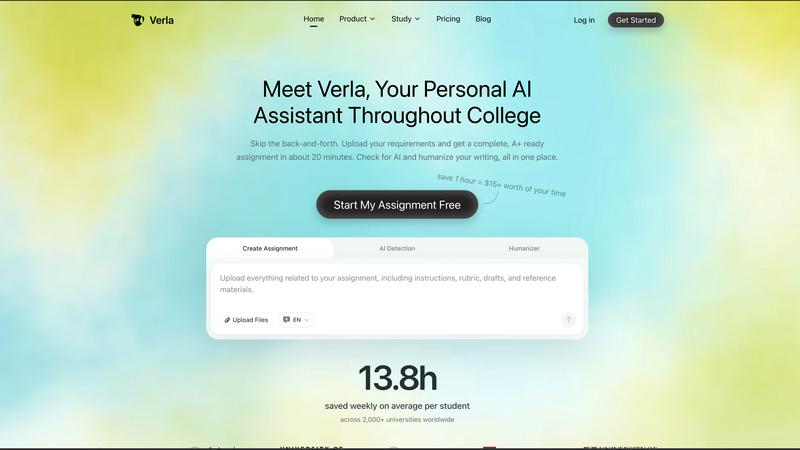
Verla helps college students draft assignments from rubrics, check AI likelihood, and refine academic writing in one workflow.
Categories
Pricing
About Verla
For college work that involves a rubric, reading list, and a specific deliverable, Verla offers a workflow that starts with supplied requirements and proceeds through drafting and review. The product says it can use rubrics, lecture notes, PDFs, books, datasets, and examples. Its scope includes essays, research papers, presentations, coding projects, and data analysis, with a typical generation run described as about 20 minutes.
Verla's AI detector analyzes sentences and paragraphs to show passages that may need attention. A humanizer then aims to improve tone while preserving the argument and citations. The site lists APA, MLA, Chicago, IEEE, Harvard, and Vancouver references. This breadth may suit students handling varied tasks, but the final check remains theirs: verify sources, correct mistakes, and make sure AI assistance is allowed for the assignment.
Features
- Works from assignment requirements, rubrics, and course materials
- Produces drafts across writing and non-writing formats
- AI likelihood analysis highlights specific passages
- Humanizer aims to retain cited evidence and meaning
Use cases
- Draft a research paper from a rubric and reading list
- Create slides, speaker notes, or a pitch deck for class
- Work on a coding or data analysis assignment
- Check and revise a draft before submission
Frequently asked questions
How does Verla use assignment requirements?
It can take uploaded rubrics and supporting materials into account when preparing an assignment.
What does the AI detector provide?
It gives an AI likelihood score and detailed sentence- and paragraph-level analysis.
What formats can it help prepare?
Verla lists essays, reports, presentations, coding projects, and data analysis among its supported formats.
Similar products
Compare alternatives
Flux3Max.io
Flux3Max.io generates 5 to 20 second videos with sound from text, still images, or a timeline of up to 10 keyframes.

InterviewAce
InterviewAce uses a resume and job description to surface live interview talking points, with mock practice and feedback for job candidates.

FindTourGuide
FindTourGuide helps travelers request several local tour quotes at once, then compare proposed itineraries and contact operators directly.

SysRound
Explore questions from 489 companies and prepare with coding plans, an interview workspace, and system design mock rounds.

Evalyy
Turn chapter PDFs into exam-ready quizzes, multilingual video explainers, and a chapter-aware AI tutor for students, teachers, and parents.

Beautyface
Beautyface is an AI photo editor for prompt-based retouching, background and outfit changes, plus portrait creation from reusable shoot templates.

CodexFuse Solution
All-in-One Managed IT Platform on Credits — Hosting, VPS, AI Agents, Business Email & Software Development

Rhinobird
Rhinobird turns product photos and packaging artwork into listing images, ad creatives and product videos for ecommerce teams.