AutoPhish vs Playwriter
Side-by-side comparison to help you choose the right product.

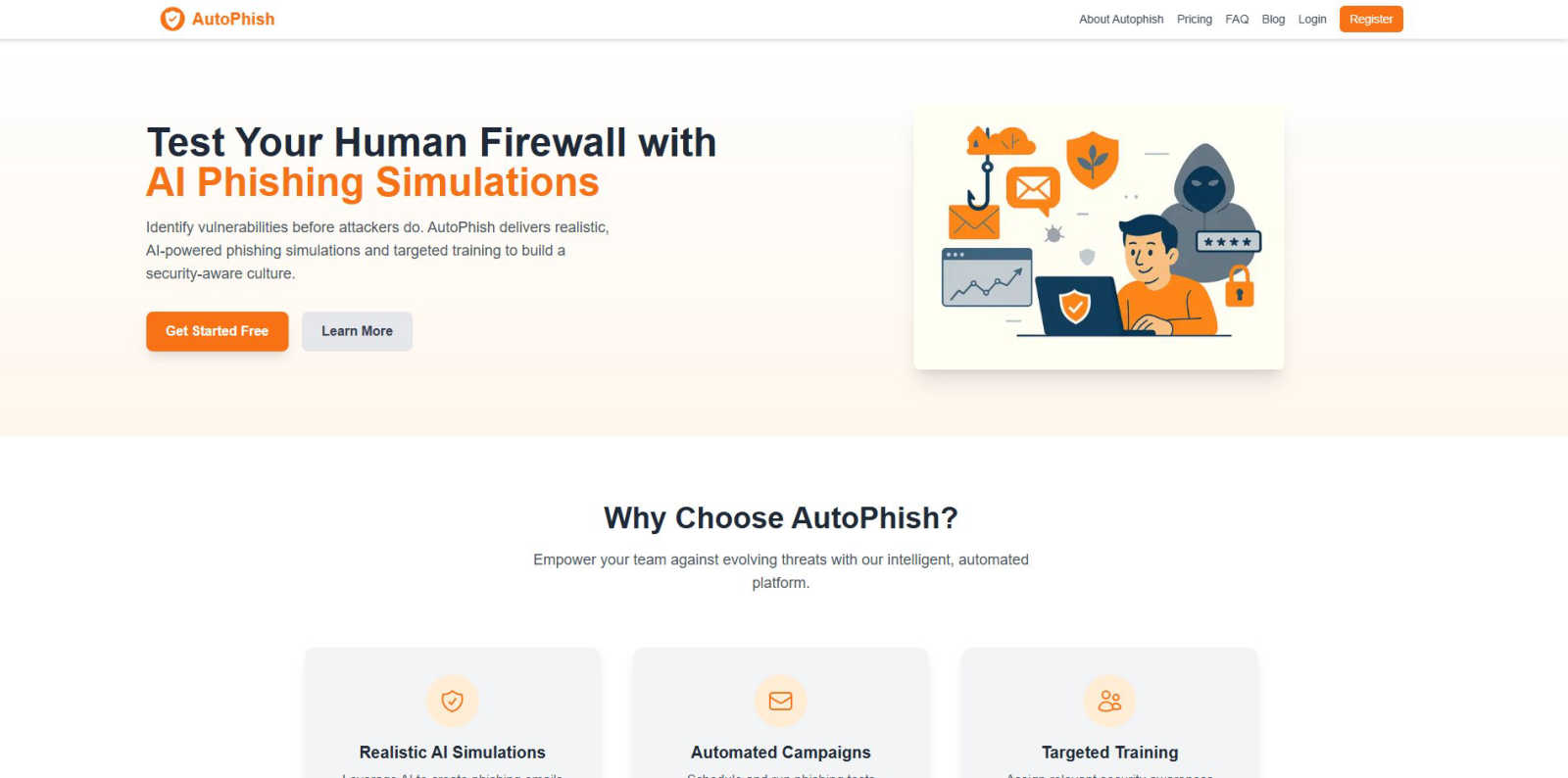
AutoPhish uses AI to automate realistic phishing simulations and training that strengthen your team's security.
Last updated: March 1, 2026

Playwriter
Playwriter lets AI agents control your actual Chrome browser with all your logins and extensions intact.
Last updated: March 18, 2026
Visual Comparison
AutoPhish
Playwriter

Feature Comparison
AutoPhish
Realistic AI-Powered Phishing Simulations
AutoPhish leverages advanced artificial intelligence to craft phishing email templates that are indistinguishable from real-world attacks. The AI tailors these simulations to your specific industry, incorporating current threat intelligence and social engineering tactics to test your employees under highly realistic conditions. This ensures your security assessments are relevant and challenging, providing accurate data on where your vulnerabilities truly lie.
Automated Campaign Management
The platform allows you to schedule and run phishing tests automatically, removing manual effort and ensuring your security awareness program runs consistently. You can configure campaigns to target specific user groups, choose from a library of AI-generated templates, and set them to execute on a recurring basis. This automation guarantees regular testing without ongoing administrative overhead, freeing your IT team to focus on other critical security tasks.
Targeted Security Awareness Training
Based on the results of phishing simulations, AutoPhish intelligently assigns follow-up security training to users who need it most. Training modules are tailored to user roles and the specific types of phishing lures they fell for. This personalized approach ensures that educational interventions are relevant and effective, directly addressing the knowledge gaps revealed by the simulation data to drive meaningful behavioral change.
Comprehensive Reporting & Analytics
After each campaign, AutoPhish provides detailed, advanced reports that break down performance metrics. You can monitor click rates, identify vulnerable users and departments, and track progress over time. These actionable insights allow security leaders to measure ROI, demonstrate program effectiveness to stakeholders, and make data-driven decisions to continuously improve the organization's cybersecurity resilience.
Playwriter
Your Real Browser Session
Playwriter's core feature is granting AI agents access to your live Chrome session. Instead of launching a separate, "headless" browser that lacks identity and history, the agent operates directly in your open browser tabs. All your active logins, saved cookies, browser extensions (like ad blockers or password managers), and cached data are immediately available. This eliminates the friction of re-authenticating for every task and dramatically reduces the chance of being detected as a bot, as the browser fingerprint matches your legitimate, daily use.
Full Playwright API via a Single Tool
Unlike other MCP implementations that expose a limited, predefined set of browser actions (like "click" or "type"), Playwriter provides agents with the entire Playwright automation library through one execute tool. This means the agent can write and run any valid Playwright code—from complex interactions and network interception to performance profiling. This approach avoids "schema bloat" from dozens of individual tool definitions, keeping context usage low for AI models and providing maximum flexibility for tackling any web task.
Advanced Debugging & Inspection Suite
Playwriter transforms your browser into a debuggable runtime for AI agents. It includes a full-featured debugger where you can set breakpoints to pause execution, live-edit code on the fly, and step through commands. The tool also provides network interception to monitor and modify HTTP requests/responses and built-in screen recording to capture video of the agent's actions. This suite is invaluable for developing, testing, and understanding complex automation workflows.
Lightweight Accessibility Snapshots
Instead of relying on large, inefficient screenshots (often 100KB+), Playwriter generates compact accessibility snapshots (5-20KB). These snapshots provide the AI agent with a structured, semantic view of the page, including element roles, names, states, and a logical reading order. This allows the agent to understand the page layout and interact with elements reliably using ARIA attributes, all while consuming minimal context tokens and speeding up processing.
Use Cases
AutoPhish
Proactive Vulnerability Identification for IT Teams
Security and IT administrators use AutoPhish to proactively find weaknesses in their human firewall before real attackers do. By running regular, automated simulations, they gain a clear, ongoing picture of employee susceptibility, allowing them to allocate training resources effectively and reduce the organization's overall risk profile based on concrete data rather than assumptions.
Compliance and Audit Readiness
Organizations in regulated industries utilize AutoPhish to meet compliance requirements for security awareness training and testing. The platform provides documented proof of regular phishing simulations and tailored employee education, which is essential for audits against standards like ISO 27001, SOC 2, GDPR, and others that mandate ongoing security awareness programs.
Onboarding and Continuous Employee Education
HR and security teams integrate AutoPhish into the employee onboarding process to establish security awareness from day one. Furthermore, they use its automated scheduling to deliver continuous education through quarterly or monthly simulated campaigns, ensuring that security remains top-of-mind for all staff and knowledge is regularly refreshed as threats evolve.
Measuring Security Program Effectiveness
CISOs and security managers employ AutoPhish's analytics to quantitatively measure the impact of their security awareness investments. By tracking metrics like click-rate trends over time and department-specific performance, they can demonstrate ROI, justify security budgets, and showcase a tangible improvement in the organization's defensive culture to executive leadership.
Playwriter
Automated Testing & QA with Real User Data
Developers and QA engineers can use Playwriter to create and run automated tests that execute within a genuine user context. Since the agent uses your real browser session, tests can automatically navigate through authenticated areas of web applications, test features behind paywalls, or verify flows that depend on specific cookies or local storage—scenarios that are cumbersome or impossible to test with traditional, isolated automation frameworks.
AI-Powered Research & Data Extraction
For researchers, analysts, or anyone needing to gather information from multiple web sources, Playwriter enables AI agents to conduct deep, session-aware research. The agent can log into academic journals, navigate complex multi-page search results, accept cookie consents, and extract structured data—all while maintaining login sessions across different websites. You collaborate by handling unexpected pop-ups or CAPTCHAs in real-time.
Repetitive Web Task Automation
Automate tedious, daily web tasks without writing complex scripts. An AI agent powered by Playwriter can log into your admin dashboard, generate and download reports, fill out recurring forms, or monitor specific pages for changes. Because it works in your browser, it can access internal company tools or portals that require specific corporate authentication, turning multi-step manual processes into a single command.
Collaborative Web Development & Debugging
Front-end developers can work alongside an AI agent to debug issues. You can instruct the agent to reproduce a bug, intercept network calls to inspect API payloads, set breakpoints on specific user interactions, and take snapshots of problematic states. This turns the AI into a pair-programming partner that can manipulate the browser and inspect its state at a level of detail that goes beyond simple chat instructions.
Overview
About AutoPhish
AutoPhish is an AI-powered cybersecurity platform designed to strengthen your organization's primary line of defense: your employees. It addresses the critical human factor in security by providing realistic, AI-generated phishing simulations and targeted awareness training. The platform is built for organizations of all sizes that need to proactively identify security vulnerabilities, measure employee susceptibility to phishing, and build a resilient, security-aware culture. Its core value proposition lies in moving beyond generic training to deliver hyper-realistic, context-aware phishing tests that mimic the exact tactics used by real attackers targeting your specific industry. By automating the entire process—from campaign scheduling and execution to result analysis and personalized training assignments—AutoPhish saves security teams valuable time and ensures consistent, measurable improvement in your organization's security posture. Ultimately, it empowers your team with the practical knowledge to recognize and respond to sophisticated phishing attempts, effectively turning your workforce into a robust human firewall against evolving cyber threats.
About Playwriter
Playwriter is a revolutionary developer tool that solves the fundamental problem of web automation for AI agents: access. Traditional methods force agents to operate in a sterile, isolated browser environment—a fresh Chrome instance with no logins, no extensions, and no cookies, which is instantly flagged by bot detection systems. Playwriter takes the opposite approach. It gives AI agents direct, programmable control over your actual, everyday Chrome browser session through a simple Chrome extension and CLI. This means your agents can interact with websites where you're already logged in, with your preferred extensions active, and with your existing cookies and local storage intact. It leverages the powerful Playwright automation API, exposing it through a single, flexible tool for AI clients via the Model Context Protocol (MCP). The result is robust, human-like browsing that bypasses common automation blocks, uses far less memory than spawning new browser instances, and enables deep debugging and inspection capabilities. It's open-source (MIT licensed), runs entirely locally, and is designed for developers and power users who need reliable, collaborative automation that works with the web as it exists for real users.
Frequently Asked Questions
AutoPhish FAQ
How does AutoPhish ensure simulations are realistic?
AutoPhish uses advanced AI models trained on real-world phishing attack data to generate email content. The platform allows customization and tailors lures based on your industry, making the simulations highly relevant and convincing. This approach mimics the sophisticated tactics used by actual attackers, providing a true test of your employees' vigilance.
Is it safe to send simulated phishing emails to my employees?
Yes. AutoPhish requires you to verify and monitor your domain's email security settings (SPF, DKIM, DMARC) before sending. This ensures emails are sent securely and are properly authenticated. The simulations are designed to be safe educational tools; they do not install malware or steal credentials, and users are directed to a training page if they interact with the simulated phishing email.
What happens if an employee fails a phishing test?
When an employee clicks a link or interacts with a simulated phishing email, they are immediately directed to a brief, constructive training module that explains what they missed and how to identify similar threats in the future. Administrators are notified, and the platform can automatically assign more comprehensive follow-up training based on the user's role and the specific simulation.
Can I target specific departments or user groups?
Absolutely. AutoPhish provides granular control over campaign targeting. You can create user groups based on department, location, or job function and launch tailored phishing simulations for each group. This allows for more relevant testing and enables you to focus training efforts where they are needed most, such as targeting finance with invoice fraud scams.
Playwriter FAQ
How does Playwriter handle security and privacy?
Playwriter is designed with a strong local-first principle. All connections are made via a WebSocket relay running on your local machine (localhost:19988). No browser data, automation commands, or screenshots are sent to any remote server. The extension only communicates with the local relay, and you have full control over which tabs the agent can access by clicking the extension icon to attach or detach. You are always in the driver's seat.
Can I use Playwriter with any AI assistant or IDE?
Yes, Playwriter is built on the open Model Context Protocol (MCP), which is supported by a growing number of clients. This includes popular AI-powered IDEs like Cursor and Windsurf, AI assistants like Claude Desktop, and code editors like VS Code with appropriate extensions. As long as your client supports MCP, you can connect it to the Playwriter server and begin automating.
What happens if the agent gets stuck or encounters a CAPTCHA?
This is where Playwriter's collaborative nature shines. You are watching the browser in real-time. If the agent encounters a CAPTCHA, a unexpected pop-up, or simply gets stuck in a loop, you can manually intervene. You can solve the CAPTCHA yourself, click the necessary button, or even temporarily detach the extension from that tab to fix the state manually. Once you re-enable the extension, the agent can continue from the new state.
Is Playwriter only for Chrome?
Currently, Playwriter is implemented as a Chrome extension, so it requires the Chrome or a Chromium-based browser (like Brave, Edge, or Arc) to function. The automation API it exposes is Playwright, which is cross-browser, but the mechanism for attaching to your live session is specific to the Chrome DevTools Protocol (CDP) via the browser's extension system.
Alternatives
AutoPhish Alternatives
AutoPhish is an AI-powered cybersecurity platform in the Business Intelligence and Productivity category. It automates phishing simulations and security training to help organizations identify vulnerabilities and improve employee awareness against evolving threats. Users often explore alternatives for various reasons. These can include budget constraints, the need for different feature sets, or specific integration requirements with existing security tools. Some organizations may also seek platforms with different reporting capabilities or training content libraries. When evaluating alternatives, consider the realism and customization of the phishing simulations, the depth and relevance of the accompanying training modules, and the clarity of the reporting dashboard. The ideal solution should seamlessly fit your technical environment and effectively measure improvement in your team's security posture over time.
Playwriter Alternatives
Playwriter is an open-source automation tool that allows AI agents to control a real, logged-in Chrome browser session via CLI or the Model Context Protocol. It solves the core problem of AI agents having either no web access or a sterile, temporary browser that lacks user data and triggers bot detection. This places it in the automation category, specifically for bridging AI and practical web interaction. Users often seek alternatives for various reasons. Some may require a different pricing model, such as a fully hosted service versus self-hosted software. Others might need specific features not present in one tool, or require integration with a different platform or ecosystem beyond MCP clients like Cursor or Claude. When evaluating alternatives, key considerations include how the tool handles browser sessions—whether it provides a fresh instance or a persistent, authenticated one. Also assess the depth of automation capabilities, the quality of debugging and observability features, and the overall architecture regarding security, privacy, and extensibility. The ideal choice aligns with your specific workflow and technical requirements.