Collab Chain vs Interactive Circle of Fifths
Side-by-side comparison to help you choose the right product.

Collab Chain turns royalty statements into tamper-proof proof for music collaborators.
Last updated: February 28, 2026

Interactive Circle of Fifths
Master music theory and composition with an interactive tool for scales, chords, and progressions.
Last updated: March 1, 2026
Visual Comparison
Collab Chain

Interactive Circle of Fifths
Feature Comparison
Collab Chain
Deterministic Proof Generation
Collab Chain creates verifiable, tamper-evident royalty proof from your official statements. The platform preserves your original uploaded file and generates a deterministic snapshot of the data, which can be independently verified at any time in the future. This process ensures the record is immutable and serves as a defensible source of truth, moving beyond guesswork or easily disputed spreadsheets.
Enforced Split Confirmation
The platform provides clear, track-level split status indicators showing Complete, Incomplete, or Not Set. You cannot finalize and lock a proof until all collaborator splits are confirmed and total 100%. This built-in validation prevents accidental omissions or incomplete agreements, ensuring every record is fully documented and ready for sharing or legal scrutiny.
Secure, Read-Only Sharing
Generate secure, shareable links for collaborators, managers, or legal teams without compromising your account security. Recipients can view a proof summary and its details in a read-only format that requires no Collab Chain account to access. This allows you to provide transparency and proof without granting editing rights or exposing sensitive login information.
Hybrid Document Support
Collab Chain accepts official PDF or CSV exports from distributors, publishers, and PROs as the foundation for verifiable proofs. For platforms that block exports, you can add dashboard screenshots as labeled "Supporting Evidence." These images are never parsed for calculations and are clearly marked as "Not an Official Statement," maintaining integrity while providing necessary context.
Interactive Circle of Fifths
Dynamic Key and Chord Exploration
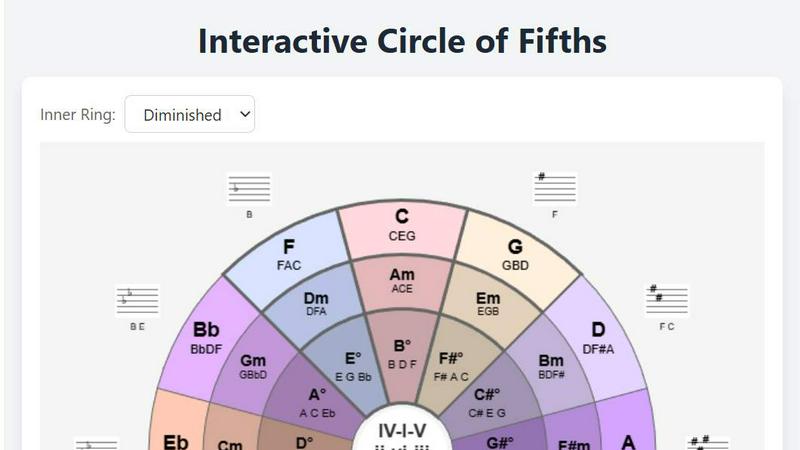
Instantly explore the complete harmonic landscape of any key. By selecting a root note, the circle updates to display all seven diatonic chords (I, ii, iii, IV, V, vi, vii°) for that key, such as C, Dm, Em, F, G, Am, and B° for C major. This feature solves the problem of memorizing chord families by providing an interactive, color-coded map. Clicking any chord plays its sound, helping you internalize its quality and function within the key's context, making theory a tangible, auditory experience.
Multi-Instrument Fingering Visualizers
Overcome the hurdle of translating theory to your instrument with dedicated piano and guitar visualizers. When you select a chord or scale, the software displays the precise fingering positions on a virtual piano keyboard and guitar fretboard. This direct visual connection eliminates guesswork, allowing you to learn chord shapes, scale patterns, and their relationships on your specific instrument, accelerating muscle memory and practical skill development during practice sessions.
Comprehensive Scale Library and Harmonization
Move beyond basic major and minor scales with an integrated library of essential musical colors. The inner ring provides instant access to the Pentatonic, Blues, Diatonic, and Diminished scales from any root. The "Harmonized Scale" panel shows how each note of a scale translates into a chord, demystifying how melodies and harmonies are built. This feature is a powerful solution for composers and improvisers looking to understand which scales work over which chord progressions and how to create richer, more informed musical ideas.
Chord Sequencer and Functional Analysis
Build and experiment with chord progressions effortlessly using the Chord Sequencer. Drag and drop chords from the harmonized scale panel to create sequences and hear how they flow together. The "Function" labels (like "Scale Degree" and "Resolves To") teach you the role each chord plays, solving the problem of creating aimless progressions. This hands-on tool empowers you to craft professional-sounding progressions, understand cadences, and learn the rules of harmonic movement through direct experimentation.
Use Cases
Collab Chain
Independent Artist Portfolio Management
An independent artist releasing music across multiple distributors and collaborators can use Collab Chain to consolidate all their royalty statements into one organized system. They can confirm splits with every featured artist and producer, lock the proofs, and maintain a verifiable portfolio of their earnings and credits. This clean record is crucial for securing loans, negotiating label deals, or providing proof of income.
Producer Credit Verification
A producer who works on multiple tracks for different artists can document their production credits and royalty percentages definitively. Instead of relying on memory or informal DMs, they upload the official statements received from artists or labels, confirm their split, and generate a locked proof. This becomes their authoritative record for accounting, tax purposes, and resolving any future disputes over payment.
Songwriter Split Documentation
Songwriters in a co-writing session can use Collab Chain to permanently document agreed-upon publishing splits once the song earns royalties. When PRO statements arrive, each writer uploads their copy, maps the data, and confirms their percentage. The resulting proof protects each writer's share, simplifying royalty collections and ensuring fair compensation is indisputable.
Manager & Legal Team Auditing
A manager overseeing a roster of artists can use Collab Chain to organize and audit royalty statements from various sources for each client. They can verify that all collaborator splits are correctly reported and generate shareable proof links to send to legal teams during contract reviews or audit preparations, streamlining due diligence and protecting their clients' interests.
Interactive Circle of Fifths
Accelerating Music Theory Comprehension for Beginners
For new musicians, traditional theory can feel like learning a foreign language from a textbook. This tool makes it visual and interactive. A beginner can click on "C Major" and immediately see and hear all the chords that belong to that key, then see where to play them on a guitar or piano. This transforms abstract concepts like the "I-IV-V" progression into a clear, audible, and playable pattern, dramatically shortening the learning curve and building a solid foundational understanding from day one.
Songwriting and Chord Progression Development
Songwriters often hit creative blocks or rely on the same few chords. Using the Chord Sequencer, a writer can select a key, explore its related chords, and drag different combinations (like I-V-vi-IV) to build a progression. Hearing it play back instantly allows for rapid experimentation with different emotional feels. The functional analysis (e.g., "V resolves to I") provides the "why" behind what sounds good, empowering writers to break out of creative ruts and compose with more intention and variety.
Instrument-Specific Practice and Fretboard/Keyboard Mastery
Guitarists and pianists struggling to learn scales or chord inversions across the entire instrument can use the visualizers for targeted practice. A guitarist wanting to master the blues scale in A can select it and see the pattern across the entire fretboard, not just one box position. A pianist can explore different voicings for a G7 chord. This turns the tool into a personalized, interactive practice companion for mastering the geography of your instrument in any key or mode.
Improvisation and Solo Construction
Improvisers can quickly find the correct scales and arpeggios to play over any chord change. By setting up a chord progression in the sequencer (e.g., C - Am - F - G), a musician can then select the "Diatonic Scale" to see the parent C major scale, or click on individual chords to see their related arpeggios or pentatonic variations. This provides an instant, reliable roadmap for constructing solos that are harmonically appropriate, solving the common problem of "getting lost" during a solo.
Overview
About Collab Chain
Collab Chain is a dedicated verification platform that solves a critical, costly problem in the music industry: the lack of clear, trusted, and defensible proof of ownership and royalty splits. Built for creators, producers, songwriters, managers, and rights holders, it transforms the chaos of scattered royalty statements, informal agreements, and ambiguous paperwork into a single, tamper-evident source of truth. The platform does not distribute music or process payments; its sole focus is on verification and documentation. Users upload official documents from distributors, PROs, or publishers, and Collab Chain parses and normalizes this data to generate a structured, deterministic record that serves as undeniable proof of contribution and entitlement. By providing immutable clarity and transparency, Collab Chain reduces disputes, builds trust between collaborators, and creates a secure "credit locker" essential for professional negotiations, audits, and conflict resolution. It is an indispensable tool for anyone who needs clean, organized, and reliable records of their creative work and earnings, turning administrative vulnerability into professional leverage.
About Interactive Circle of Fifths
The Interactive Circle of Fifths is a dynamic, all-in-one music theory platform designed to solve the common problem of abstract and disconnected theory learning. It transforms the classic Circle of Fifths from a static diagram into an interactive, auditory, and visual learning environment. This tool is built for musicians of all levels—beginners who find theory daunting, intermediate players looking to deepen their understanding, and advanced performers/composers seeking a quick reference for improvisation and songwriting. Its core value proposition lies in making complex harmonic relationships instantly understandable and audible. By allowing users to click on any key and instantly see, hear, and play the associated chords and scales, it bridges the gap between theoretical knowledge and practical application. The integration of piano and guitar fingerboard visualizers directly ties theory to your instrument, ensuring you can immediately apply what you learn. Whether your goal is to understand why certain chords work together, memorize scales, build chord progressions, or improvise solos, this software provides the practical, hands-on solution to move your musicianship forward efficiently.
Frequently Asked Questions
Collab Chain FAQ
What kind of files does Collab Chain accept?
Collab Chain accepts official PDF or CSV export files from music distributors (like DistroKid, TuneCore), streaming platforms (like Apple Music for Artists, Spotify for Artists), and Performing Rights Organizations (PROs) or publishers. These official documents form the basis of a verifiable proof. For platforms that do not allow exports, you can upload PNG or JPG screenshots as "Supporting Evidence," which are clearly labeled as not being official statements.
Does Collab Chain pull my live streaming data or handle payments?
No. Collab Chain does not scrape dashboards, pull live data from DSPs, or handle any payments. Its purpose is strictly verification and documentation. You manually upload your existing official royalty statements, and the platform helps you structure, confirm, and lock that data into an immutable proof. You remain in control of your data and your payment relationships.
What happens after I finalize and lock a proof?
Once you finalize a record, Collab Chain performs server-side validation to confirm statement integrity and split completeness before permanently locking it. The system ensures no partial records exist through transactional rollback. After locking, you can download a proof PDF or a full export bundle for your records and generate secure, read-only links to share the verified proof with others.
How does Collab Chain ensure my data is secure and tamper-proof?
Your original uploaded files are preserved in their exact state. The proof generation process is deterministic, meaning the same input file will always produce the same verifiable output snapshot. Once a proof is locked, it cannot be altered. Any supporting evidence added later is clearly timestamped and labeled, ensuring a clear audit trail and maintaining the integrity of the original, parsed data.
Interactive Circle of Fifths FAQ
Is the Interactive Circle of Fifths suitable for complete beginners?
Absolutely. The tool is designed specifically to demystify music theory for beginners. By making relationships visual and audible, it provides an intuitive entry point. You don't need prior theory knowledge to start clicking on keys and hearing chords. The instrument visualizers then show you exactly how to play those concepts, making it an ideal all-in-one starting resource for learning the fundamentals in a practical, non-intimidating way.
Can I use this tool for instruments other than piano and guitar?
While the dedicated visualizers are for piano and guitar, the core theory concepts are universal. The Circle of Fifths, chord functions, scale relationships, and chord progressions apply to all melodic instruments (like saxophone, violin, or voice) and music production (DAWs). Musicians on other instruments can use the tool to deeply understand harmony and theory, then apply that knowledge to their instrument's specific fingering system.
How does the "Resolves To" function help me?
The "Resolves To" label identifies the natural harmonic tendency of chords, most importantly showing that the V chord (dominant) strongly resolves to the I chord (tonic). This is the foundation of musical tension and release. Understanding this helps you create satisfying chord progressions, craft better bass lines that follow these movements, and improvise solos that highlight these key harmonic moments, making your music sound more coherent and purposeful.
What is the difference between the Diatonic Scale and the Harmonized Scale panel?
The Diatonic Scale (e.g., C D E F G A B) shows you the raw notes of the scale for a chosen key. The Harmonized Scale panel shows you what chord is built on each of those scale degrees (C, Dm, Em, etc.). Essentially, the Diatonic Scale is the melody notes, while the Harmonized Scale is the chords you get from stacking notes from that scale. This panel is crucial for understanding how chords are derived from scales and how they function together.
Alternatives
Collab Chain Alternatives
Collab Chain is a productivity and management platform designed specifically for music collaborators. It focuses on creating verifiable, tamper-proof records from royalty statements to serve as a single source of truth for ownership and splits. Users may look for alternatives for various reasons, such as budget constraints, a need for different feature sets like integrated payments or project management, or a preference for a more general-purpose tool. The specific needs of a solo artist differ from those of a large label or management team. When evaluating alternatives, consider your core need: is it purely for documentation and proof, or do you require payment processing, collaboration tools, or broader rights management? Key factors include the platform's security, ease of use, ability to handle your statement formats, and how it facilitates transparency and trust with your collaborators.
Interactive Circle of Fifths Alternatives
The Interactive Circle of Fifths is a comprehensive music theory software designed for education and learning. It helps musicians visualize and understand chord relationships, scales, and fingerings to improve their composition and improvisation skills. Users often explore alternatives for various reasons. These can include budget constraints, a need for different features like specific instrument focus or songwriting tools, or compatibility with a preferred device or operating system. Some may seek simpler, more specialized tools or more advanced, professional-grade suites. When evaluating other options, consider your primary learning goals. Look for tools that clearly explain music theory concepts, offer practical visualizations for your instrument, and provide interactive features that encourage active practice. The right alternative should match your skill level and help you solve specific musical challenges.