Playwriter vs qtrl.ai
Side-by-side comparison to help you choose the right product.

Playwriter
Playwriter lets AI agents control your actual Chrome browser with all your logins and extensions intact.
Last updated: March 18, 2026

qtrl.ai
qtrl.ai helps QA teams scale testing with AI agents while maintaining full control and governance.
Last updated: March 4, 2026
Visual Comparison
Playwriter

qtrl.ai
Feature Comparison
Playwriter
Your Real Browser Session
Playwriter's core feature is granting AI agents access to your live Chrome session. Instead of launching a separate, "headless" browser that lacks identity and history, the agent operates directly in your open browser tabs. All your active logins, saved cookies, browser extensions (like ad blockers or password managers), and cached data are immediately available. This eliminates the friction of re-authenticating for every task and dramatically reduces the chance of being detected as a bot, as the browser fingerprint matches your legitimate, daily use.
Full Playwright API via a Single Tool
Unlike other MCP implementations that expose a limited, predefined set of browser actions (like "click" or "type"), Playwriter provides agents with the entire Playwright automation library through one execute tool. This means the agent can write and run any valid Playwright code—from complex interactions and network interception to performance profiling. This approach avoids "schema bloat" from dozens of individual tool definitions, keeping context usage low for AI models and providing maximum flexibility for tackling any web task.
Advanced Debugging & Inspection Suite
Playwriter transforms your browser into a debuggable runtime for AI agents. It includes a full-featured debugger where you can set breakpoints to pause execution, live-edit code on the fly, and step through commands. The tool also provides network interception to monitor and modify HTTP requests/responses and built-in screen recording to capture video of the agent's actions. This suite is invaluable for developing, testing, and understanding complex automation workflows.
Lightweight Accessibility Snapshots
Instead of relying on large, inefficient screenshots (often 100KB+), Playwriter generates compact accessibility snapshots (5-20KB). These snapshots provide the AI agent with a structured, semantic view of the page, including element roles, names, states, and a logical reading order. This allows the agent to understand the page layout and interact with elements reliably using ARIA attributes, all while consuming minimal context tokens and speeding up processing.
qtrl.ai
Enterprise-Grade Test Management
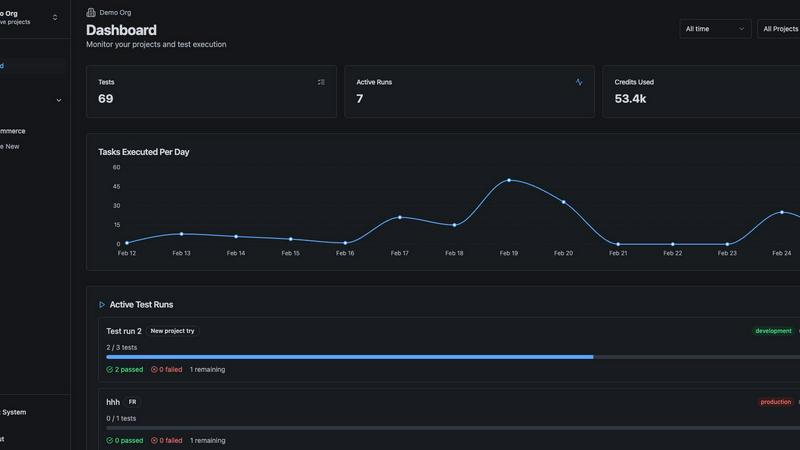
qtrl provides a centralized command center for all QA activities. Teams can create and organize test cases, build detailed test plans, execute manual and automated test runs, and establish clear traceability from requirements to test coverage. Real-time dashboards offer instant visibility into quality metrics, pass/fail rates, and potential risk areas, making it ideal for managers and leads who need audit trails and compliance-ready reporting without sacrificing agility.
Progressive AI & Autonomous Agents
This feature introduces intelligent automation at your team's pace. Start by writing simple, high-level test instructions in plain English for the AI agent to execute. As trust builds, leverage agents to automatically generate full UI test scripts from descriptions, maintain them through application changes, and run them at scale across multiple browsers and environments. All AI suggestions are fully reviewable and approvable, ensuring humans remain in the loop and governance is never compromised.
Adaptive Memory & Context Awareness
qtrl's AI builds a living, evolving knowledge base of your application. It learns from every interaction—including exploratory testing, test execution results, and logged issues. This accumulated context powers smarter, more accurate test generation over time. The system becomes more effective and aware of your specific application's behavior and coverage gaps, proactively suggesting new tests to improve overall quality.
Multi-Environment Execution with Governance
Execute tests securely across any environment—development, staging, or production. qtrl supports per-environment configuration variables and encrypted secrets, ensuring sensitive data like API keys or passwords are never exposed to the AI agents. You define default environments and rules, giving agents permissioned autonomy to operate at scale while maintaining stringent security and operational controls.
Use Cases
Playwriter
Automated Testing & QA with Real User Data
Developers and QA engineers can use Playwriter to create and run automated tests that execute within a genuine user context. Since the agent uses your real browser session, tests can automatically navigate through authenticated areas of web applications, test features behind paywalls, or verify flows that depend on specific cookies or local storage—scenarios that are cumbersome or impossible to test with traditional, isolated automation frameworks.
AI-Powered Research & Data Extraction
For researchers, analysts, or anyone needing to gather information from multiple web sources, Playwriter enables AI agents to conduct deep, session-aware research. The agent can log into academic journals, navigate complex multi-page search results, accept cookie consents, and extract structured data—all while maintaining login sessions across different websites. You collaborate by handling unexpected pop-ups or CAPTCHAs in real-time.
Repetitive Web Task Automation
Automate tedious, daily web tasks without writing complex scripts. An AI agent powered by Playwriter can log into your admin dashboard, generate and download reports, fill out recurring forms, or monitor specific pages for changes. Because it works in your browser, it can access internal company tools or portals that require specific corporate authentication, turning multi-step manual processes into a single command.
Collaborative Web Development & Debugging
Front-end developers can work alongside an AI agent to debug issues. You can instruct the agent to reproduce a bug, intercept network calls to inspect API payloads, set breakpoints on specific user interactions, and take snapshots of problematic states. This turns the AI into a pair-programming partner that can manipulate the browser and inspect its state at a level of detail that goes beyond simple chat instructions.
qtrl.ai
Scaling Beyond Manual Testing
QA teams overwhelmed by repetitive manual test cycles can use qtrl to systematically introduce automation. They begin by structuring their existing manual cases in the platform, then progressively offload execution to AI agents. This allows the team to scale test coverage and frequency without linearly increasing headcount, freeing human testers to focus on complex, exploratory, and high-value testing activities.
Modernizing Legacy QA Workflows
Companies relying on outdated, siloed, or script-heavy automation frameworks can modernize without a risky "big bang" replacement. qtrl integrates with existing tools and processes, allowing teams to gradually transition. They can maintain current scripts while using qtrl's AI to generate new, more maintainable tests and centralize all management and reporting, reducing technical debt and brittleness over time.
Ensuring Governance in Enterprise AI Adoption
Enterprises that require strict compliance, audit trails, and control can safely adopt AI for QA. qtrl's permissioned autonomy, full visibility into agent actions, and review gates ensure that all automation is transparent and accountable. This allows large organizations to gain the speed benefits of AI while meeting internal security, regulatory, and governance mandates without relying on unpredictable "black-box" solutions.
Accelerating Product-Led Engineering Teams
Fast-moving product and engineering teams that need rapid quality feedback can integrate qtrl into their CI/CD pipelines. Developers and product managers can write high-level test instructions for features, and qtrl's agents can automatically generate and run the corresponding tests. This creates continuous quality feedback loops, catches regressions early, and helps maintain high release velocity without creating a testing bottleneck.
Overview
About Playwriter
Playwriter is a revolutionary developer tool that solves the fundamental problem of web automation for AI agents: access. Traditional methods force agents to operate in a sterile, isolated browser environment—a fresh Chrome instance with no logins, no extensions, and no cookies, which is instantly flagged by bot detection systems. Playwriter takes the opposite approach. It gives AI agents direct, programmable control over your actual, everyday Chrome browser session through a simple Chrome extension and CLI. This means your agents can interact with websites where you're already logged in, with your preferred extensions active, and with your existing cookies and local storage intact. It leverages the powerful Playwright automation API, exposing it through a single, flexible tool for AI clients via the Model Context Protocol (MCP). The result is robust, human-like browsing that bypasses common automation blocks, uses far less memory than spawning new browser instances, and enables deep debugging and inspection capabilities. It's open-source (MIT licensed), runs entirely locally, and is designed for developers and power users who need reliable, collaborative automation that works with the web as it exists for real users.
About qtrl.ai
qtrl.ai is a modern, AI-powered QA platform designed to solve the fundamental scaling challenges faced by software development teams. It bridges the gap between slow, manual testing processes and the brittle, expensive complexity of traditional test automation. qtrl provides a unified solution that combines enterprise-grade test management with intelligent, trustworthy AI automation. This allows teams to organize test cases, plan runs, trace requirements, and track quality metrics from a single centralized hub, ensuring full visibility and governance. The platform's progressive approach to AI is its key differentiator; instead of forcing a risky, fully autonomous model, it allows teams to start with structured manual management and gradually introduce AI agents that can generate, maintain, and execute UI tests from plain English. Built for product-led engineering teams, QA groups moving beyond manual testing, and enterprises requiring strict compliance, qtrl offers a controlled, step-by-step path to faster, more intelligent, and scalable quality assurance without sacrificing oversight or trust.
Frequently Asked Questions
Playwriter FAQ
How does Playwriter handle security and privacy?
Playwriter is designed with a strong local-first principle. All connections are made via a WebSocket relay running on your local machine (localhost:19988). No browser data, automation commands, or screenshots are sent to any remote server. The extension only communicates with the local relay, and you have full control over which tabs the agent can access by clicking the extension icon to attach or detach. You are always in the driver's seat.
Can I use Playwriter with any AI assistant or IDE?
Yes, Playwriter is built on the open Model Context Protocol (MCP), which is supported by a growing number of clients. This includes popular AI-powered IDEs like Cursor and Windsurf, AI assistants like Claude Desktop, and code editors like VS Code with appropriate extensions. As long as your client supports MCP, you can connect it to the Playwriter server and begin automating.
What happens if the agent gets stuck or encounters a CAPTCHA?
This is where Playwriter's collaborative nature shines. You are watching the browser in real-time. If the agent encounters a CAPTCHA, a unexpected pop-up, or simply gets stuck in a loop, you can manually intervene. You can solve the CAPTCHA yourself, click the necessary button, or even temporarily detach the extension from that tab to fix the state manually. Once you re-enable the extension, the agent can continue from the new state.
Is Playwriter only for Chrome?
Currently, Playwriter is implemented as a Chrome extension, so it requires the Chrome or a Chromium-based browser (like Brave, Edge, or Arc) to function. The automation API it exposes is Playwright, which is cross-browser, but the mechanism for attaching to your live session is specific to the Chrome DevTools Protocol (CDP) via the browser's extension system.
qtrl.ai FAQ
How does qtrl.ai ensure the AI doesn't make unpredictable changes?
qtrl is built on a principle of "permissioned autonomy." The AI does not make changes or execute tests without review and approval, unless explicitly configured to do so within strict rules you define. All AI-generated test scripts and modifications are presented for human review first. You maintain full visibility into every action the agent takes, ensuring there are no "black-box" decisions and you remain in complete control.
Can qtrl.ai work with our existing tools and CI/CD pipeline?
Yes, qtrl is designed to integrate into real-world workflows. It offers requirements management integration, supports connections to CI/CD pipelines for automated test execution as part of your build process, and provides APIs to work with your existing toolchain. It acts as a centralized QA layer that complements your current development ecosystem rather than forcing a complete replacement.
Is qtrl suitable for teams with no prior test automation experience?
Absolutely. qtrl's progressive approach is ideal for teams starting their automation journey. You can begin by using it purely as a test management tool. When ready, you can start with simple, English-language instructions for the AI to execute, which requires no coding. This allows teams to build automation expertise and trust in the platform gradually, at their own pace.
How does qtrl handle testing across different environments and with sensitive data?
qtrl provides robust multi-environment execution capabilities. You can define different environments (dev, staging, prod) with their own variables. Crucially, sensitive data like passwords or API keys can be stored as encrypted secrets that are injected at runtime. The AI agents never have direct access to these raw secrets, ensuring security and compliance when testing across various stages of your deployment pipeline.
Alternatives
Playwriter Alternatives
Playwriter is an open-source automation tool that allows AI agents to control a real, logged-in Chrome browser session via CLI or the Model Context Protocol. It solves the core problem of AI agents having either no web access or a sterile, temporary browser that lacks user data and triggers bot detection. This places it in the automation category, specifically for bridging AI and practical web interaction. Users often seek alternatives for various reasons. Some may require a different pricing model, such as a fully hosted service versus self-hosted software. Others might need specific features not present in one tool, or require integration with a different platform or ecosystem beyond MCP clients like Cursor or Claude. When evaluating alternatives, key considerations include how the tool handles browser sessions—whether it provides a fresh instance or a persistent, authenticated one. Also assess the depth of automation capabilities, the quality of debugging and observability features, and the overall architecture regarding security, privacy, and extensibility. The ideal choice aligns with your specific workflow and technical requirements.
qtrl.ai Alternatives
qtrl.ai is a modern QA platform in the automation and dev tools category. It helps software teams scale their testing efforts by combining enterprise-grade test management with trustworthy AI automation, allowing for a gradual and controlled adoption of intelligent agents. Users often explore alternatives for various reasons. These can include budget constraints, the need for different feature sets, specific platform integrations, or simply evaluating the market to ensure a tool aligns perfectly with their team's size, tech stack, and workflow maturity. When considering other options, focus on your core needs. Look for a solution that balances robust test management with the level of automation you require. Key evaluation points should include governance controls, the transparency of any AI features, ease of integration into your development lifecycle, and the overall scalability to support your team's growth without introducing unnecessary complexity.