
Renderly vs Seedance 2 AI Video Generator
Side-by-side comparison to help you choose the right product.

Renderly
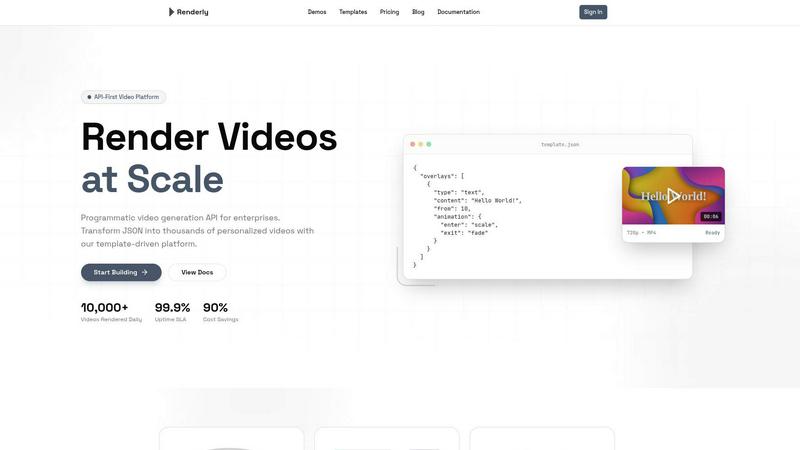
Renderly automates video production at scale, enabling enterprises to generate thousands of personalized videos.
Last updated: February 26, 2026

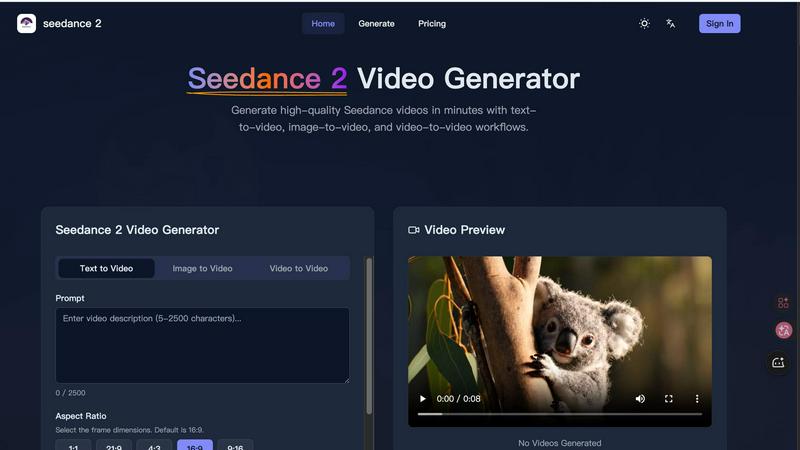
Seedance 2.0 instantly creates cinematic videos from your text, images, or clips with consistent quality.
Last updated: March 1, 2026
Visual Comparison
Renderly
Seedance 2 AI Video Generator
Feature Comparison
Renderly
API-First Architecture
Renderly's RESTful API is designed for high-volume video generation, enabling seamless integration into existing applications and workflows. Comprehensive documentation, webhooks, and SDKs provide developers with the tools they need for effective implementation.
Template Management
The centralized template library allows users to manage and version control video templates easily. With JSON configuration and dynamic content support, users can create highly personalized videos by simply replacing variables in their templates.
Scalable Infrastructure
Renderly operates on a cloud-native platform with auto-scaling capabilities. This means that it can handle thousands of concurrent rendering requests, ensuring reliability and performance as your video production needs grow.
Cost-Effective Billing
Renderly offers a transparent credit-based billing system that allows users to pay only for what they render. With volume discounts and the potential for up to 90% cost savings compared to competitors, businesses can optimize their video production budgets effectively.
Seedance 2 AI Video Generator
Multimodal Input Flexibility
Seedance 2.0 supports three distinct generation modes: Text-to-Video, Image-to-Video, and Video-to-Video. This flexibility allows you to start from a written concept, a visual style reference, or existing footage you want to extend or restyle. You are not limited to a single starting point, enabling workflows tailored for concepting, maintaining brand consistency, or quickly adapting existing content for new campaigns.
Reference-First Generation for Consistency
A key differentiator is its reference-driven workflow. Instead of relying solely on prompt wording, you can upload a reference image or video clip to anchor the AI's output. This provides superior control over character appearance, artistic style, color palette, and camera feel, ensuring generated videos maintain visual coherence and align closely with your creative vision, significantly reducing revision cycles.
Integrated Audio-Video Synthesis
The platform can generate synchronized audio alongside your video in a single pass. This includes background sound effects (SFX), musical scores, and even voice dialogue with accurate lip-sync for over 10 languages. This eliminates the need for separate audio sourcing and complex editing to match sound with visuals, creating a more immersive and production-ready final product efficiently.
Advanced Control Parameters
Users have fine-grained control over their video outputs. The interface allows you to specify duration (up to 10 seconds per generation), aspect ratio (16:9, 9:16, 1:1), resolution (up to 1080p), and frame rate (up to 24fps). Combined with a generous 2500-character prompt window, these controls let you precisely tailor videos for specific platforms like social media, websites, or presentations.
Use Cases
Renderly
Personalized Marketing Campaigns
Businesses can use Renderly to generate personalized marketing videos for each customer, enhancing engagement and conversion rates. By automating this process, companies can create tailored content at scale without the manual effort.
Social Media Content Creation
Social media managers can leverage Renderly to produce bulk video content tailored for various platforms. Whether it's promotional clips or informative videos, Renderly's API allows for rapid production to keep up with the fast-paced nature of social media.
Data-Driven Motion Graphics
For organizations that rely on data visualization, Renderly can automate the creation of motion graphics based on real-time data. This capability allows teams to produce compelling visual stories that are both informative and engaging, enhancing data communication.
E-Learning Video Production
Educational institutions and e-learning platforms can utilize Renderly to create a vast array of instructional videos. By automating video generation, educators can focus on content quality while ensuring that their video resources remain plentiful and up-to-date.
Seedance 2 AI Video Generator
Rapid Social Media Content Creation
Marketing teams and social media managers can use Seedance 2.0 to quickly produce a high volume of engaging, platform-optimized video clips. By generating multiple versions of product demos, promotional teasers, or educational snippets from text prompts or brand image references, they can maintain a consistent and active content calendar without extensive production resources.
Concept Visualization and Storyboarding
Filmmakers, ad agencies, and creative directors can leverage the tool to visualize concepts rapidly. Turning a script excerpt or a mood board image into a short, animated video sequence allows for effective pitching, client feedback, and internal alignment early in the creative process, saving time and resources before moving to full-scale production.
Product Demonstration and Explainer Videos
E-commerce brands and SaaS companies can create clear, attractive videos to showcase product features or explain complex services. The Image-to-Video mode is perfect for animating product photos, while Text-to-Video can generate scenarios showing the product in use, helping to boost conversion rates and improve customer understanding.
Content Repurposing and Restyling
Content creators and media houses can breathe new life into existing footage. The Video-to-Video mode allows for restyling old clips with new visual effects, adapting content for different seasonal campaigns, or extending a short clip seamlessly. This maximizes the value of existing media libraries and accelerates the production of derivative content.
Overview
About Renderly
Renderly is a cutting-edge video infrastructure platform designed specifically for developers and content creators who seek to automate video production at scale. With its programmatic video generation capabilities, Renderly allows users to transform JSON data into thousands of personalized videos quickly and efficiently. This makes it an ideal solution for enterprises and businesses that want to generate bulk video content, such as personalized marketing videos, social media clips, or data-driven motion graphics. The platform's API-first design ensures seamless integration into existing workflows, allowing teams to focus on creativity rather than manual rendering processes. By offering robust tools and a centralized template library, Renderly empowers users to scale their video production while also achieving significant cost savings. With Renderly, you can stop rendering videos by hand and embrace a more efficient, automated approach to video content creation.
About Seedance 2 AI Video Generator
Seedance 2.0 is a next-generation AI video generator designed to transform creative concepts into polished, cinematic videos with unprecedented speed and control. It solves the core problem of time-consuming and technically complex video production by offering a fast, all-in-one workflow. Creators can generate videos from simple text prompts, reference images, or existing source footage, making it a versatile tool for a wide range of visual storytelling needs. The platform is specifically built for creators, marketers, and agencies who need to produce high-quality video content rapidly without the heavy overhead of traditional editing software or lengthy rendering times. Its main value proposition lies in delivering professional-grade video output with superior consistency, smoother motion, and a reference-first approach that reduces guesswork. By integrating multiple input modes and advanced features like synchronized audio generation and multilingual lip-sync, Seedance 2.0 streamlines the entire production pipeline from initial idea to final, shareable video clip.
Frequently Asked Questions
Renderly FAQ
How does Renderly's API work?
Renderly's API allows developers to generate videos programmatically by sending requests with JSON data. The platform processes these requests and produces videos according to the specified templates, enabling automation and scalability.
What types of video formats does Renderly support?
Renderly supports multiple video formats, including MP4, which is widely used for online video content. This ensures that videos created on the platform can be easily shared across various platforms without compatibility issues.
Is Renderly suitable for small businesses?
Absolutely. Renderly is designed to scale with your needs, making it a viable option for small businesses looking to enhance their video marketing efforts. The cost-effective pricing model allows businesses of all sizes to benefit from automated video production.
What security measures does Renderly have in place?
Renderly is SOC 2 compliant and employs robust security measures, including data encryption, access controls, and audit logging. This ensures that user data and video content are protected throughout the rendering process.
Seedance 2 AI Video Generator FAQ
What are the main input methods for Seedance 2.0?
Seedance 2.0 offers three primary input methods: Text-to-Video, where you describe your scene; Image-to-Video, where you upload a reference image to guide style and composition; and Video-to-Video, where you provide source footage for extension or stylistic transformation. This multimodal approach provides maximum flexibility for different creative starting points.
How does Seedance 2.0 ensure character and style consistency?
The platform uses a reference-first generation model. By uploading a reference image or video, you provide a concrete visual anchor for the AI. This instructs the model on specific details like character appearance, clothing, art style, and color grading, leading to much more consistent outputs across multiple generations compared to systems relying on text prompts alone.
Can Seedance 2.0 generate videos with sound?
Yes, Seedance 2.0 features integrated audio synthesis. It can generate synchronized audio that includes background sound effects, musical scores, and voice dialogue. A standout feature is its support for multilingual lip-sync, ensuring spoken words match the character's mouth movements in over 10 languages for a cohesive viewing experience.
What are the technical specifications for the output video?
Videos can be generated with durations typically between 5 to 10 seconds, extendable through multiple generations. The maximum output resolution is 1080p (Full HD) with a cinema-standard frame rate of up to 24 frames per second. You can choose from common aspect ratios like 16:9 (landscape), 9:16 (portrait), and 1:1 (square), with final videos delivered in the universal MP4 (H.264) format.
Alternatives
Renderly Alternatives
Renderly is a video infrastructure platform designed to automate video production through code, enabling developers and creators to generate thousands of videos quickly using a robust API or an online editor. It caters to various needs, whether for personalized videos, bulk social media content, or data-driven motion graphics, streamlining workflows and enhancing productivity. Users often seek alternatives to Renderly due to factors such as pricing, specific feature sets, or the need for different platform capabilities that better suit their projects. When considering alternatives, it's essential to evaluate the features offered, ease of integration, scalability, and customer support to ensure that the chosen solution aligns with your video production requirements and goals.
Seedance 2 AI Video Generator Alternatives
Seedance 2 AI Video Generator is a powerful tool in the AI video creation category, designed to transform text, images, and existing clips into cinematic-quality videos quickly. Its focus on consistent character references, smooth scene extensions, and intuitive prompt control makes it a strong option for creators seeking an all-in-one workflow. Users often explore alternatives for various practical reasons. These can include budget constraints, the need for different feature sets like more advanced editing controls or specific output formats, or compatibility with their existing software ecosystem. Some may also seek platforms with different subscription models or usage limits that better match their project volume. When evaluating other options, consider your primary needs. Key factors include the quality and consistency of AI-generated footage, the flexibility of the input methods (text, image, video), the overall speed of the rendering process, and the learning curve. The right tool should align with your specific creative goals and technical requirements without unnecessary complexity.