TinyHunt vs Wire
Side-by-side comparison to help you choose the right product.

TinyHunt
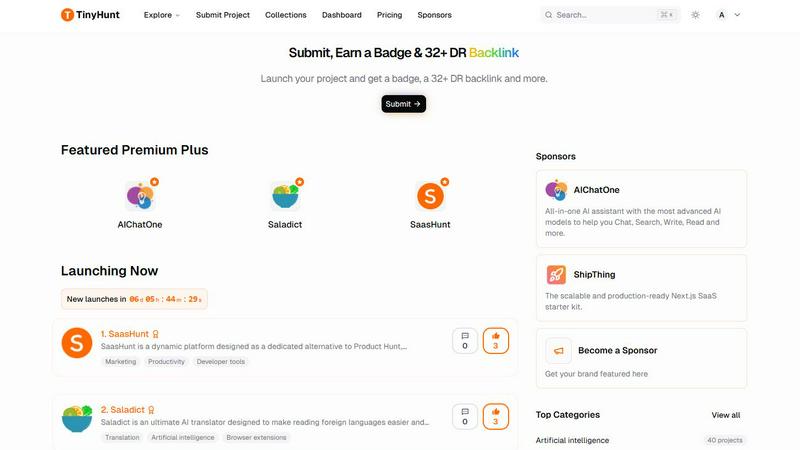
TinyHunt gives indie products a weekly spotlight to gain visibility and valuable backlinks.
Last updated: March 1, 2026

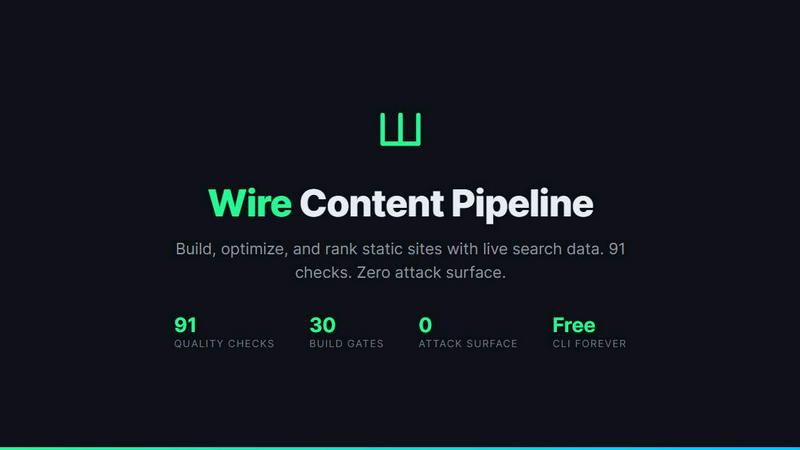
Wire is a content operations CLI that makes your AI-written content rank by running 91 quality checks before publishing.
Last updated: April 4, 2026
Visual Comparison
TinyHunt
Wire
Feature Comparison
TinyHunt
Weekly Curated Showcase
Each week, TinyHunt features a fresh batch of hand-picked tools from indie makers and tiny businesses. This curation ensures quality and relevance, saving users from sifting through endless, unvetted options. The weekly rotation keeps the platform dynamic and constantly updated with the latest innovations.
Time-Bound Product Spotlight
Every featured product receives maximum visibility for a strict 7-day period. This creates a sense of urgency and focus, driving concentrated traffic and engagement to each launch. For makers, it means a guaranteed burst of attention and feedback during their critical launch phase.
Valuable Launch Benefits for Makers
Submitting a project to TinyHunt provides immediate, tangible benefits for growth. Creators earn a promotional badge for their site and a powerful backlink from a domain with a 32+ DR (Domain Rating), which significantly boosts SEO. This package is designed to amplify online presence and credibility from day one.
Active Community & Discussion Platform
TinyHunt fosters an environment for genuine interaction beyond passive browsing. Users can explore, discuss, and provide direct feedback on featured products. This transforms simple discovery into a collaborative community where builders can connect with early adopters and refine their offerings based on real input.
Wire
Autonomous Content Optimization Pipeline
Wire integrates every stage of content operations into one automated workflow. It begins by reading your actual Google Search Console data to identify underperforming pages and genuine keyword opportunities you already rank for. It then handles the rewrite or creation process, enforcing a configurable style guide to maintain your brand voice. Finally, every piece of content must pass 91 deterministic quality checks covering SEO elements, readability, and technical integrity before the site is built. This pipeline eliminates manual jumping between disparate tools.
Strict Build-Time Quality Enforcement
Unlike dashboard tools that only warn you of problems, Wire integrates quality checks directly into the build system. If it detects thin content, title tag violations, broken internal links, AI writing patterns, keyword cannibalization, or stale content, it will refuse to generate the static site files. There are no ignorable warnings; issues must be resolved before publishing. This ensures that only compliant, high-standard content ever reaches your live site.
Local-First & Privacy-Centric Operation
Wire runs entirely on your local machine. Your proprietary search performance data from Google Search Console and all your content never leave your environment. This provides maximum security and privacy. The output is static HTML, requiring no database or server, which eliminates common attack vectors and allows for free, fast hosting on platforms like GitHub Pages.
AI Agent Bot Protocol
Wire is designed for automation beyond scheduled runs. Its "bot protocol" provides a structured interface that allows an AI agent to operate your website autonomously. Once configured, the agent can use Wire to conduct site audits, rewrite underperforming content, integrate the latest news, manage internal linking, and deploy updates. This transforms your site into a self-maintaining system that continuously improves based on real search data.
Use Cases
TinyHunt
Launching a New Indie Product
A solo founder has just launched a niche SaaS tool. By submitting to TinyHunt, they gain immediate exposure to a targeted audience of early adopters and professionals. The week-long feature drives initial sign-ups, gathers crucial early feedback, and provides a strong SEO backlink to help establish domain authority from the start.
Discovering Niche Productivity Tools
A marketing manager needs to find a specialized, efficient tool for a specific task, like AI-powered proposal generation. Instead of wasting hours searching generic directories, they visit TinyHunt. The curated weekly list presents them with a shortlist of promising, recently launched tools like QuoterAgent, allowing for quick evaluation and adoption.
Sourcing Tools for Agency Operations
A small digital agency wants to stay ahead of the curve by using the latest independent software to improve their internal workflows and client services. They use TinyHunt as a reliable radar for new, vetted tools. They can efficiently find solutions for project management, design, or client reporting that are often more agile and cost-effective than large enterprise software.
Building Social Proof & Backlink Profile
An indie developer has a functional product but lacks online authority and references. Being featured on TinyHunt provides legitimate social proof as a "featured" product. The included badge and high-quality backlink directly enhance their website's credibility and search engine ranking, which is vital for attracting future customers and partnerships.
Wire
Migrating from WordPress to a Static, Automated Stack
Businesses tired of WordPress bloat, security concerns, and plugin management can use Wire to migrate their existing content. Wire converts the site into a static, locally-managed repository. Post-migration, all content updates, optimizations, and technical SEO are handled through Wire's automated pipeline, drastically reducing maintenance overhead and improving site speed and security.
Scaling AI-Generated Content with Quality Assurance
Teams using ChatGPT or Claude to produce content at scale face issues with consistency, voice, and SEO gaps. Wire acts as the essential enforcement layer. It wraps the AI model with a style guide, runs post-generation auto-fixes, and subjects every article to 91 rigorous checks. This ensures the scaled output aligns with brand voice, is fully optimized, and is free of common AI tells before it ever publishes.
Proactive Site Maintenance and Recovery
Instead of waiting for a Google algorithm update to reveal site-wide issues, Wire enables proactive maintenance. It continuously audits all pages for title drift, broken links, content freshness, and internal linking. By automatically identifying and flagging these issues during the build process, Wire prevents traffic drops before they happen and systematically recovers underperforming pages through data-driven rewrites.
Running a Hands-Off, Agent-Managed Website
For developers and entrepreneurs, Wire's bot protocol enables the ultimate hands-off operation. After initial setup, an AI agent can be tasked with running the entire content lifecycle: analyzing GSC data, deciding which pages to update, rewriting them, checking for cannibalization, and deploying the improved site. This creates a fully autonomous content operation that grows organic traffic without daily manual intervention.
Overview
About TinyHunt
TinyHunt is a specialized discovery platform designed to solve a critical visibility problem for independent creators and a discovery problem for savvy users. It acts as a curated, time-bound launchpad exclusively for tiny businesses, indie developers, and solo founders. The platform cuts through the noise of overwhelming, static product directories by featuring a new, carefully selected batch of innovative tools and software each week. Every product gets a prominent, focused spotlight for exactly 7 days, creating a high-traffic window for genuine discovery, user feedback, and community discussion. For builders, this model provides essential visibility, valuable backlinks (including a 32+ Domain Rating link), and social proof to kickstart growth. For professionals, marketers, and early adopters, TinyHunt serves as a trusted, efficient source to find effective, niche tools that boost productivity and offer a competitive edge, keeping them ahead of trends in the independent software market. It’s more than a list; it's an active community for exploration and a powerful catalyst for growth.
About Wire
Wire is a comprehensive content operations command-line interface (CLI) designed to replace your entire SEO and publishing technology stack. It consolidates the functionality of tools like Ahrefs, Semrush, SurferSEO, WordPress, Yoast, and Grammarly into a single, unified pipeline that runs locally on your machine. Wire is built for content teams, SEO professionals, and businesses using AI to scale content production, who need to ensure that output is high-quality, optimized, and actually ranks in search engines. Its core value proposition is ownership and enforcement: you keep your search data and content private, and Wire acts as a strict quality gate that refuses to publish until over 90 automated checks are passed. By integrating keyword research, cannibalization detection, static site generation, and direct Google Search Console analysis, Wire enables autonomous site management. You configure the system once, and its "bot protocol" can allow an AI agent to handle ongoing audits, rewrites, and deployments, turning your site into a self-improving asset.
Frequently Asked Questions
TinyHunt FAQ
How does the submission and featuring process work?
Builders can submit their project through the "Submit Project" page. The TinyHunt team curates submissions and selects a new batch of products to feature each week. If selected, your product will be prominently displayed on the homepage and across the platform for a full 7 days, receiving all the associated launch benefits.
What are the benefits of submitting my project?
The primary benefits include a week of focused exposure to a targeted audience, a "Featured on TinyHunt" badge for your website, and a valuable backlink from a site with a 32+ Domain Rating (DR) to boost your SEO. This combination drives traffic, builds credibility, and improves your site's search engine authority.
Is there a cost to submit or be featured?
Based on the provided context, there is a "Submit" call-to-action and a "Pricing" page, suggesting there may be both free and paid submission options. The "Featured Premium Plus" section indicates certain spots may be sponsored or enhanced. For specific costs, you should refer to the official TinyHunt Pricing page for the most accurate and current information.
Who is the TinyHunt audience?
The audience consists of professionals actively seeking new tools, including early adopters, marketers, product managers, other founders, and investors. They are specifically interested in discovering innovative, niche software from the independent maker community to solve business problems, enhance productivity, and find competitive advantages.
Wire FAQ
How does Wire differ from using separate SEO tools?
Traditional SEO tools like Ahrefs or Semrush are dashboards that show you problems but don't fix them. They also rely on estimated, third-party data. Wire uses your real Google Search Console data and integrates the entire process from analysis to fix to enforcement. It doesn't just report a broken link or thin content; it blocks your site from building until you fix it, creating a closed-loop system that guarantees quality.
Can I use Wire with my existing static site generator (e.g., Hugo, Astro)?
Wire is not a plugin for another static site generator; it is a complete content operations platform that includes its own static site generation as part of its pipeline. It is designed as an all-in-one replacement. However, you can migrate your existing content from systems like Hugo or MkDocs into Wire's structure to benefit from its integrated SEO and automation features.
What happens when Wire "refuses to build"?
If Wire encounters a critical issue during its 91 quality checks—such as a title tag over 60 characters, a missing meta description, or two pages targeting the same primary keyword—it will halt the build process and output a detailed error report. You must address the specific issues listed in the report before Wire will successfully generate your static site files. This prevents problematic content from going live.
Is there a managed service if I don't want to run Wire myself?
Yes. While Wire is designed to run locally for full control and privacy, the team offers a managed service for hands-off operation. With this option, the Wire team manages the infrastructure, runs the pipelines, and handles updates, allowing you to reap the benefits of automated content operations without managing the CLI tool directly.
Alternatives
TinyHunt Alternatives
TinyHunt is a curated discovery platform in the product launch and indie marketing space. It provides indie makers and tiny businesses with a weekly spotlight to gain visibility, feedback, and valuable backlinks from a targeted audience. Users often seek alternatives for various reasons. Some may need a platform with a different pricing model, a broader or more niche-specific audience, or a permanent listing instead of a time-limited feature. Others might look for different community dynamics, submission requirements, or additional promotional services beyond basic exposure. When evaluating alternatives, consider your core goals. Key factors include the platform's audience size and relevance, the type of exposure offered (permanent listing vs. timed feature), the cost structure, and the additional benefits provided, such as SEO value or community engagement tools. The right choice aligns with your product's stage and your specific launch objectives.
Wire Alternatives
Wire is a content operations CLI tool that consolidates the entire SEO and publishing workflow into a single, locally-run pipeline. It belongs to the SEO and content management category, automating tasks from keyword research to deployment while enforcing strict quality standards. Users often explore alternatives for various reasons. Some may have budget constraints or prefer a different pricing model, while others might need specific integrations or a cloud-based platform instead of a local CLI tool. The desire for a more traditional, graphical user interface over a command-line approach is another common driver for looking at other options. When evaluating alternatives, consider your core needs. Key factors include the required feature set, such as which specific SEO checks and publishing capabilities are non-negotiable. You should also assess the deployment model, data security, and whether the tool fits into your existing team's technical skill set and workflow preferences.