
DeepRails
DeepRails detects and fixes AI hallucinations in real-time for accurate LLM applications.
Visit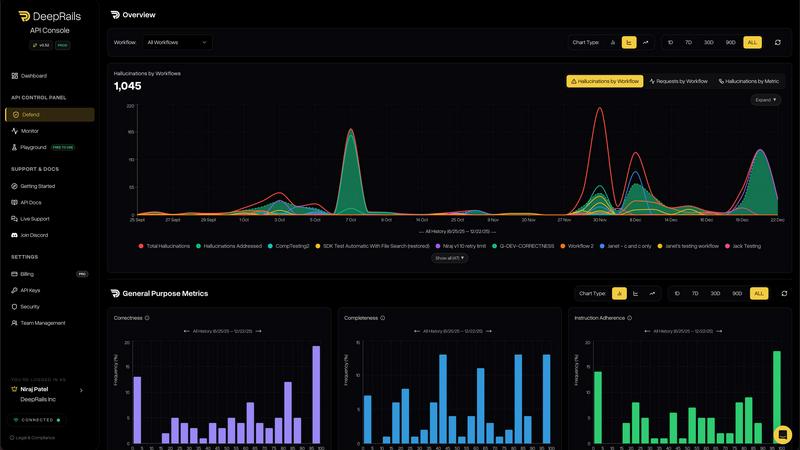
About DeepRails
DeepRails is the definitive guardrails platform engineered to eliminate AI hallucinations and unreliable outputs in production systems. It is built specifically for developers and AI engineers who need to ship trustworthy, production-grade AI applications but are held back by the risks of models generating factually incorrect or inconsistent information. The platform goes beyond simple detection; it acts as a real-time correction engine that not only identifies issues like inaccuracies, lack of grounding, or safety violations but also provides substantive fixes before flawed outputs reach end-users. With its model-agnostic architecture, DeepRails integrates seamlessly into any LLM workflow, offering automated remediation, human-in-the-loop feedback, and comprehensive analytics. This allows teams to enforce quality control, ensure outputs are logically consistent and factually correct, and ultimately focus on innovation with confidence. DeepRails provides the essential toolkit to turn unpredictable AI into a reliable, auditable, and safe component of any software product.
Features of DeepRails
Ultra-Accurate Hallucination Detection
DeepRails employs a sophisticated, expansive library of guardrail metrics to detect hallucinations with high precision. It evaluates outputs across multiple dimensions like factual correctness, completeness, and context adherence, providing granular scores (0-100) for each. Benchmarks show its core metrics, such as Correctness, are up to 45% more accurate than alternatives like AWS Bedrock, ensuring you catch even subtle inaccuracies before they cause problems.
Automated Remediation & Fixing
This is the core differentiator: DeepRails doesn't just flag problems, it fixes them. Through its Defend API, the platform can automatically trigger improvement actions like "FixIt" or "ReGen" when a hallucination is detected. This means incorrect legal citations, unsupported claims in RAG systems, or incomplete answers can be corrected in real-time within your application's workflow, preventing bad data from ever reaching your customer.
Comprehensive Analytics & Audit Console
Every interaction processed by DeepRails is logged in real-time to a detailed console. Teams gain full visibility into performance metrics, guardrail score distributions, and improvement chains. You can drill into any AI run for a complete audit trace, from the original LLM output through DeepRails' scoring and any remediation steps taken. This provides the transparency needed for debugging, compliance, and continuous model improvement.
Model-Agnostic Production Guardrails
DeepRails is built to deploy instantly into any production environment. It works with any large language model, acting as a protective middleware layer. You can configure custom guardrail workflows, set thresholds for automated actions, and integrate human feedback loops without being locked into a specific model vendor. This flexibility ensures your AI quality control system evolves with your tech stack.
Use Cases of DeepRails
Legal and Compliance Applications
For legal tech tools generating case summaries, contract clauses, or legal advice, hallucinations are a critical liability. DeepRails ensures every legal citation is verified and every claim is grounded in provided context. It automatically detects and corrects fictitious case law or incorrect statutory references, protecting firms from the severe repercussions of disseminating inaccurate legal information.
Financial Services and Advisory
In finance, inaccurate AI-generated advice on investments, regulations, or market data can lead to significant financial loss and regulatory penalties. DeepRails' correctness and completeness guardrails validate the factual accuracy of financial summaries, compliance checklists, and client communications, ensuring all output is reliable and audit-ready before being shared with clients or used internally.
Healthcare Information Systems
Patient safety depends on absolute accuracy. DeepRails is crucial for healthcare chatbots, symptom checkers, or systems summarizing medical literature. It rigorously evaluates outputs for factual correctness regarding drug interactions, treatment protocols, and medical concepts, filtering out dangerous hallucinations and ensuring information is safe, verifiable, and compliant with medical standards.
Robust RAG (Retrieval-Augmented Generation) Systems
RAG systems are prone to "context drift," where the LLM ignores retrieved documents and invents answers. DeepRails' Context Adherence metric specifically measures whether each claim is supported by the provided source material. It identifies and fixes outputs that hallucinate beyond the source context, guaranteeing your RAG assistant remains truly grounded and trustworthy.
Frequently Asked Questions
How does DeepRails actually fix a hallucination?
DeepRails offers automated remediation workflows. When its detection system scores an output below your configured threshold (e.g., for Correctness), it can trigger predefined actions. This typically involves calling a "FixIt" function that rewrites the problematic section using the original prompt and context, or a "ReGen" function that instructs your LLM to regenerate the entire response with corrective guidance, all in milliseconds.
Is DeepRails compatible with any LLM?
Yes, DeepRails is completely model-agnostic. It operates as an independent API layer that sits between your application and your chosen LLM provider (like OpenAI, Anthropic, Cohere, or open-source models). You send the LLM's output to DeepRails for evaluation and correction, meaning you can switch or upgrade your underlying models without changing your guardrail infrastructure.
What kind of metrics can I track in the console?
The DeepRails console provides comprehensive analytics. You can track high-level metrics like the volume of hallucinations caught and fixed, as well as detailed distributions for all your guardrail scores (Correctness, Completeness, Safety, etc.). For every individual AI run, you get a full trace showing the original output, the evaluation results with rationales, and the step-by-step record of any remediation applied.
How do I get started with implementing DeepRails?
Implementation is designed for developers. You can start by signing up for free access to the API. The first step is to configure a workflow in the platform, defining which guardrail metrics to use and setting thresholds for automated actions. Then, integrate the Defend API call into your application's code where you process LLM responses. SDKs and detailed API documentation are provided to streamline the integration process.