
Rock Smith
Rock Smith uses AI agents to visually test your app like a real user, eliminating flaky tests.
Visit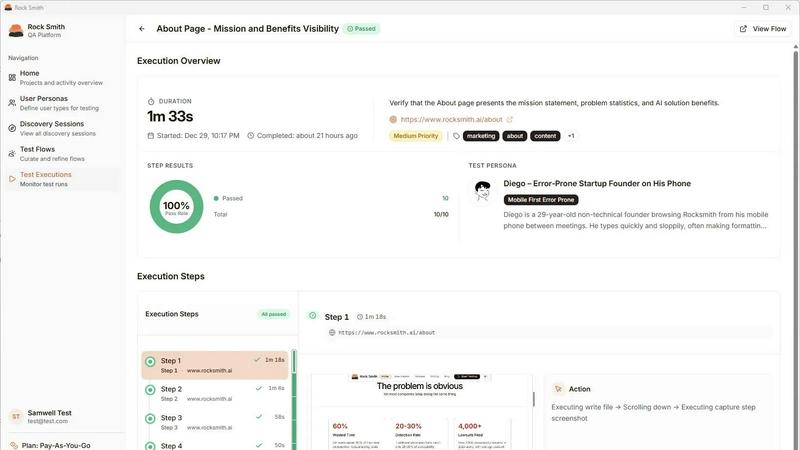
About Rock Smith
Rock Smith is an AI-powered black box testing platform that fundamentally transforms web application quality assurance. It solves the critical, time-consuming problem of brittle and high-maintenance test automation by deploying autonomous AI agents that see and interact with your application exactly like a human user. Instead of relying on fragile, code-based selectors like CSS or XPath that break with every minor UI update, Rock Smith uses advanced semantic and visual intelligence. It targets elements by their appearance, text, and context—such as "the blue Submit button below the form"—allowing tests to self-heal when the interface changes. This drastically reduces maintenance overhead and eliminates flaky tests. Built for fast-moving engineering teams, including QA engineers, developers, and product leaders, Rock Smith enables teams to ship quality software faster. Its core value proposition is freeing teams from repetitive, complex, and exploratory testing tasks, allowing them to focus on building features and strategy. By automating quality assurance with intelligent, adaptive, and secure AI agents, Rock Smith ensures robust application performance while accelerating release cycles.
Features of Rock Smith
Autonomous AI Testing Agents
Rock Smith deploys intelligent AI agents that autonomously navigate and test your web application. These agents operate by visually perceiving the UI and interacting with elements just like a human would, clicking buttons, filling forms, and validating outcomes. This eliminates the need for writing and maintaining thousands of lines of scripted test code, shifting the effort from test creation to simply defining the desired test scenarios and outcomes.
Visual and Semantic Intelligence
The platform's core engine uses computer vision and natural language processing to understand your application's interface. It identifies elements not by brittle code selectors, but by their visual characteristics, labels, and contextual placement on the page. This means tests are resilient to UI changes like color, layout shifts, or CSS class renaming, as the AI can still find "the login field" or "the checkout cart icon" based on its understanding.
Self-Healing Test Flows
When your application's user interface evolves, traditional automated tests fail and require manual updates. Rock Smith's tests are designed to self-heal. If a button moves or its label changes, the AI's semantic understanding allows it to locate the correct element to continue the test flow, dramatically reducing maintenance downtime and keeping your test suite reliable through continuous development.
Built for Engineering Teams
The platform is designed to integrate seamlessly into modern development workflows. It provides clear reporting, integrates with CI/CD pipelines, and offers collaboration features for developers, QA engineers, and business stakeholders. This ensures everyone has visibility into application quality and can trust the automated testing process, facilitating faster and more confident deployments.
Use Cases of Rock Smith
Continuous Regression Testing
Engineering teams can use Rock Smith to run comprehensive, automated regression suites after every code commit or deployment. The AI agents systematically test critical user journeys to ensure new changes don't break existing functionality. The self-healing capability makes this process sustainable, providing reliable feedback without constant test suite maintenance.
Rapid Exploratory Testing
For new features or major updates, QA teams can leverage Rock Smith to conduct intelligent exploratory testing. Instead of purely manual clicking, they can guide AI agents to probe the application, uncover edge cases, and identify visual or functional inconsistencies much faster than human-only testing, increasing test coverage and finding bugs earlier.
Cross-Browser and Cross-Device Validation
Ensuring a consistent user experience across different browsers and screen sizes is a tedious manual task. Rock Smith automates this by executing the same semantic test flows across multiple browser and viewport configurations. It validates that UI elements render correctly and interactions work as intended everywhere, streamlining compatibility testing.
User Acceptance Test (UAT) Automation
Business and product teams often perform UAT before launch, which can be slow. Rock Smith can automate these critical business workflow tests—like placing an order or generating a report—using plain-language instructions. This provides fast, repeatable validation that the application meets business requirements, speeding up the final sign-off process.
Frequently Asked Questions
How is Rock Smith different from traditional test automation tools like Selenium?
Traditional tools like Selenium rely on fragile locators (e.g., XPath, CSS selectors) tied directly to the application's code structure. When the UI changes, these locators break, causing test failures and requiring manual updates. Rock Smith uses AI to interact with the visual UI, understanding elements by what they look like and do, not just their underlying code. This makes tests far more resilient and reduces maintenance by over 90%.
Do I need coding skills to create tests with Rock Smith?
No, one of the primary advantages of Rock Smith is its codeless approach. You can create and instruct test flows using natural language and simple configurations. The AI handles the complexity of navigation and interaction. This empowers product managers, business analysts, and manual QA testers to contribute directly to test automation without writing a single line of code.
Is Rock Smith secure for testing applications with sensitive data?
Yes, security is a fundamental design principle. Rock Smith operates as a black-box testing platform, interacting only with the front end like a normal user. You have full control over the test environment and data. Sensitive information can be masked or substituted with synthetic test data, and connections are secured with enterprise-grade encryption to ensure your application data remains protected.
Can Rock Smith integrate with our existing CI/CD pipeline?
Absolutely. Rock Smith is built for modern DevOps practices. It offers robust APIs and native integrations with popular CI/CD tools like Jenkins, GitHub Actions, GitLab CI, and CircleCI. You can automatically trigger test suites on pull requests, schedule nightly regression runs, and feed test results and reports directly into your team's monitoring dashboards.