Gaffa vs qtrl.ai
Side-by-side comparison to help you choose the right product.

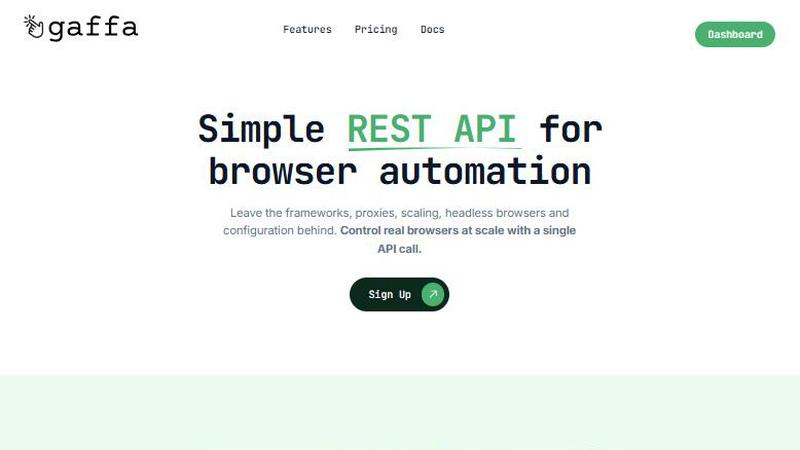
Gaffa automates real browser interactions at scale through a simple REST API.
Last updated: March 1, 2026

qtrl.ai
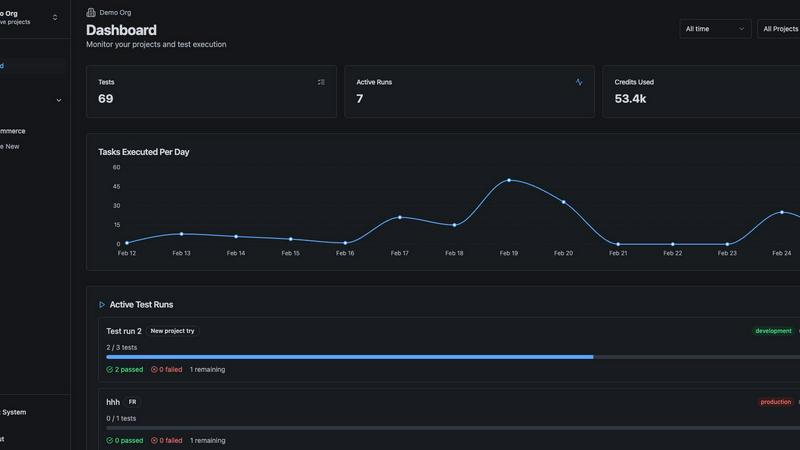
qtrl.ai helps QA teams scale testing with AI agents while maintaining full control and governance.
Last updated: March 4, 2026
Visual Comparison
Gaffa
qtrl.ai
Feature Comparison
Gaffa
Simple REST API
Gaffa abstracts the complexities of tools like Playwright, Selenium, and Puppeteer into a straightforward REST API. This means you can automate real browser actions—navigation, clicking, typing, scraping—without learning a specific framework or managing browser instances. You define the task with an API call, and Gaffa's infrastructure executes it, allowing for rapid integration and development.
Managed Proxies & Global Scaling
The platform seamlessly integrates with a network of residential proxies worldwide. You simply specify a target location, and Gaffa routes your request through a reliable proxy in that region. It also handles all scaling challenges automatically, managing concurrent requests and infrastructure resilience so you can increase your data volume without worrying about IP blocks or system failures.
Advanced Data Processing
Gaffa does more than return raw HTML. It can process page content on the fly into formats ready for your downstream applications. This includes simplified, clean HTML, LLM-ready markdown for AI pipelines, structured JSON via its LLM capabilities, and even self-contained offline versions of web pages for archival or complex analysis.
Full Observability & Stealth Mode
Every automation run is recorded, providing full visibility into what happened during each session. You can replay browser interactions to debug issues or verify data extraction. Combined with a stealth mode that mimics human browsing behavior, this feature ensures reliable data access even from sophisticated, anti-bot websites.
qtrl.ai
Enterprise-Grade Test Management
qtrl provides a centralized command center for all QA activities. Teams can create and organize test cases, build detailed test plans, execute manual and automated test runs, and establish clear traceability from requirements to test coverage. Real-time dashboards offer instant visibility into quality metrics, pass/fail rates, and potential risk areas, making it ideal for managers and leads who need audit trails and compliance-ready reporting without sacrificing agility.
Progressive AI & Autonomous Agents
This feature introduces intelligent automation at your team's pace. Start by writing simple, high-level test instructions in plain English for the AI agent to execute. As trust builds, leverage agents to automatically generate full UI test scripts from descriptions, maintain them through application changes, and run them at scale across multiple browsers and environments. All AI suggestions are fully reviewable and approvable, ensuring humans remain in the loop and governance is never compromised.
Adaptive Memory & Context Awareness
qtrl's AI builds a living, evolving knowledge base of your application. It learns from every interaction—including exploratory testing, test execution results, and logged issues. This accumulated context powers smarter, more accurate test generation over time. The system becomes more effective and aware of your specific application's behavior and coverage gaps, proactively suggesting new tests to improve overall quality.
Multi-Environment Execution with Governance
Execute tests securely across any environment—development, staging, or production. qtrl supports per-environment configuration variables and encrypted secrets, ensuring sensitive data like API keys or passwords are never exposed to the AI agents. You define default environments and rules, giving agents permissioned autonomy to operate at scale while maintaining stringent security and operational controls.
Use Cases
Gaffa
Market & Price Intelligence
Businesses can automate the monitoring of competitor websites, e-commerce product listings, and service pricing. Gaffa reliably extracts this data daily or hourly, even from JavaScript-heavy sites, enabling dynamic pricing strategies, market trend analysis, and inventory assessment without manual effort.
Lead Generation & Enrichment
Sales and marketing teams can use Gaffa to scrape public directories, social media profiles, and company websites to build targeted lead lists. The API can navigate search results, extract contact details and firmographic data, and output structured records ready for import into a CRM system.
AI & LLM Data Pipeline
For teams training or feeding large language models, Gaffa is an ideal tool for gathering high-quality, current web data. Its ability to output clean markdown and structured JSON simplifies the creation of training datasets and ensures models have access to recent information from across the web.
Content Aggregation & Monitoring
Media companies and researchers can automate the collection of news articles, blog posts, forum discussions, and regulatory updates. Gaffa can visit a list of sources, extract the relevant text and metadata, and consolidate it into a unified format for analysis, reporting, or content syndication.
qtrl.ai
Scaling Beyond Manual Testing
QA teams overwhelmed by repetitive manual test cycles can use qtrl to systematically introduce automation. They begin by structuring their existing manual cases in the platform, then progressively offload execution to AI agents. This allows the team to scale test coverage and frequency without linearly increasing headcount, freeing human testers to focus on complex, exploratory, and high-value testing activities.
Modernizing Legacy QA Workflows
Companies relying on outdated, siloed, or script-heavy automation frameworks can modernize without a risky "big bang" replacement. qtrl integrates with existing tools and processes, allowing teams to gradually transition. They can maintain current scripts while using qtrl's AI to generate new, more maintainable tests and centralize all management and reporting, reducing technical debt and brittleness over time.
Ensuring Governance in Enterprise AI Adoption
Enterprises that require strict compliance, audit trails, and control can safely adopt AI for QA. qtrl's permissioned autonomy, full visibility into agent actions, and review gates ensure that all automation is transparent and accountable. This allows large organizations to gain the speed benefits of AI while meeting internal security, regulatory, and governance mandates without relying on unpredictable "black-box" solutions.
Accelerating Product-Led Engineering Teams
Fast-moving product and engineering teams that need rapid quality feedback can integrate qtrl into their CI/CD pipelines. Developers and product managers can write high-level test instructions for features, and qtrl's agents can automatically generate and run the corresponding tests. This creates continuous quality feedback loops, catches regressions early, and helps maintain high release velocity without creating a testing bottleneck.
Overview
About Gaffa
Gaffa is a powerful web data extraction and browser automation platform designed to eliminate the technical headaches of traditional web scraping. It provides a simple REST API that gives developers, data analysts, and businesses instant access to reliable, scalable web data. The core problem Gaffa solves is infrastructure complexity. Instead of wrestling with headless browsers, proxy management, scaling challenges, and configuration failures, users send a single API call. Gaffa handles the rest, executing commands on real, fully-rendering browsers and returning the processed data. This allows teams to focus entirely on their data-driven goals—like market research, price monitoring, or lead generation—without becoming experts in browser automation frameworks. With built-in features like global residential proxies, data processing into multiple formats (HTML, markdown, JSON), and full observability with session recording, Gaffa offers a complete, production-ready solution for accessing the web at scale.
About qtrl.ai
qtrl.ai is a modern, AI-powered QA platform designed to solve the fundamental scaling challenges faced by software development teams. It bridges the gap between slow, manual testing processes and the brittle, expensive complexity of traditional test automation. qtrl provides a unified solution that combines enterprise-grade test management with intelligent, trustworthy AI automation. This allows teams to organize test cases, plan runs, trace requirements, and track quality metrics from a single centralized hub, ensuring full visibility and governance. The platform's progressive approach to AI is its key differentiator; instead of forcing a risky, fully autonomous model, it allows teams to start with structured manual management and gradually introduce AI agents that can generate, maintain, and execute UI tests from plain English. Built for product-led engineering teams, QA groups moving beyond manual testing, and enterprises requiring strict compliance, qtrl offers a controlled, step-by-step path to faster, more intelligent, and scalable quality assurance without sacrificing oversight or trust.
Frequently Asked Questions
Gaffa FAQ
What is a credit and how is it calculated?
A credit is Gaffa's unit of consumption for its API. Usage is calculated based on two factors: request time and proxy bandwidth. Browser time is billed at 1 credit per 30 seconds (2 credits if screen recording is on). Additionally, any request using a proxy location consumes 1500 credits per 1GB of bandwidth used. Each successful API call deducts the corresponding credits from your monthly allowance.
Does Gaffa offer a free trial?
Yes. You can sign up for a free account to experiment with the complete Gaffa API. This free tier allows you to build and run automations on Gaffa's dedicated demo site (demo.gaffa.dev). This provides full access to test all features and understand the workflow before upgrading to a paid plan for use on the live, open internet.
What is your refund policy?
Gaffa is happy to offer a refund if you request it within the current billing month, provided you have not yet used any credits from that month's allowance. This policy allows new users to evaluate the service on live targets with minimal risk. You can find more detailed information on the refund policy in the terms of service.
Do unused credits roll over to the next month?
No, credits do not roll over. The credit allowance included with your monthly subscription plan (Starter, Startup, Growth) is reset at the start of each new billing cycle. Any unused credits from the previous period are forfeited, so it's important to choose a plan that matches your expected usage volume.
qtrl.ai FAQ
How does qtrl.ai ensure the AI doesn't make unpredictable changes?
qtrl is built on a principle of "permissioned autonomy." The AI does not make changes or execute tests without review and approval, unless explicitly configured to do so within strict rules you define. All AI-generated test scripts and modifications are presented for human review first. You maintain full visibility into every action the agent takes, ensuring there are no "black-box" decisions and you remain in complete control.
Can qtrl.ai work with our existing tools and CI/CD pipeline?
Yes, qtrl is designed to integrate into real-world workflows. It offers requirements management integration, supports connections to CI/CD pipelines for automated test execution as part of your build process, and provides APIs to work with your existing toolchain. It acts as a centralized QA layer that complements your current development ecosystem rather than forcing a complete replacement.
Is qtrl suitable for teams with no prior test automation experience?
Absolutely. qtrl's progressive approach is ideal for teams starting their automation journey. You can begin by using it purely as a test management tool. When ready, you can start with simple, English-language instructions for the AI to execute, which requires no coding. This allows teams to build automation expertise and trust in the platform gradually, at their own pace.
How does qtrl handle testing across different environments and with sensitive data?
qtrl provides robust multi-environment execution capabilities. You can define different environments (dev, staging, prod) with their own variables. Crucially, sensitive data like passwords or API keys can be stored as encrypted secrets that are injected at runtime. The AI agents never have direct access to these raw secrets, ensuring security and compliance when testing across various stages of your deployment pipeline.
Alternatives
Gaffa Alternatives
Gaffa is a web data extraction and browser automation tool in the productivity and management category. It simplifies the process by providing a single API to automate real browsers, handling complexities like proxies and scaling so users can focus on gathering data. Users often explore alternatives for several practical reasons. These can include budget constraints, the need for different feature sets like on-premise deployment, or specific integration requirements with existing tech stacks. The search for a different solution is a normal part of finding the right tool for a project's unique demands. When evaluating alternatives, key considerations should include the ease of use and learning curve, the reliability and stealth of data extraction, the quality of proxy management, and the flexibility of data output formats. The goal is to find a solution that removes technical friction and reliably delivers the data you need.
qtrl.ai Alternatives
qtrl.ai is a modern QA platform in the automation and dev tools category. It helps software teams scale their testing efforts by combining enterprise-grade test management with trustworthy AI automation, allowing for a gradual and controlled adoption of intelligent agents. Users often explore alternatives for various reasons. These can include budget constraints, the need for different feature sets, specific platform integrations, or simply evaluating the market to ensure a tool aligns perfectly with their team's size, tech stack, and workflow maturity. When considering other options, focus on your core needs. Look for a solution that balances robust test management with the level of automation you require. Key evaluation points should include governance controls, the transparency of any AI features, ease of integration into your development lifecycle, and the overall scalability to support your team's growth without introducing unnecessary complexity.