iGPT vs Karolium
Side-by-side comparison to help you choose the right product.

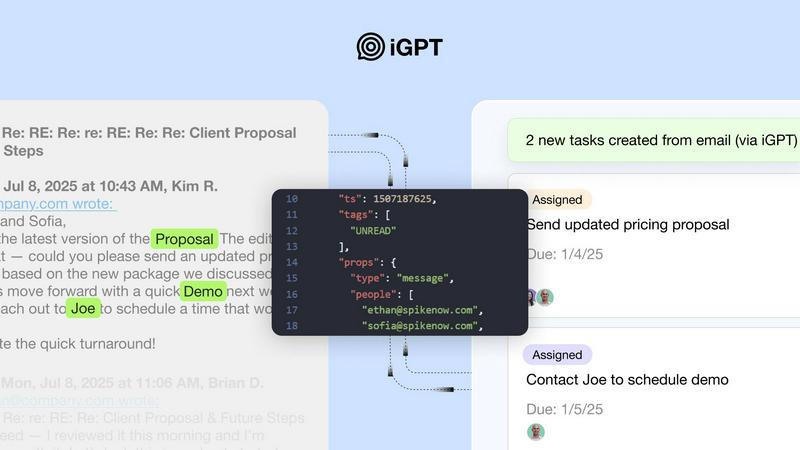
iGPT gives AI agents secure, contextual answers directly from your team's email and attachments.
Last updated: February 28, 2026

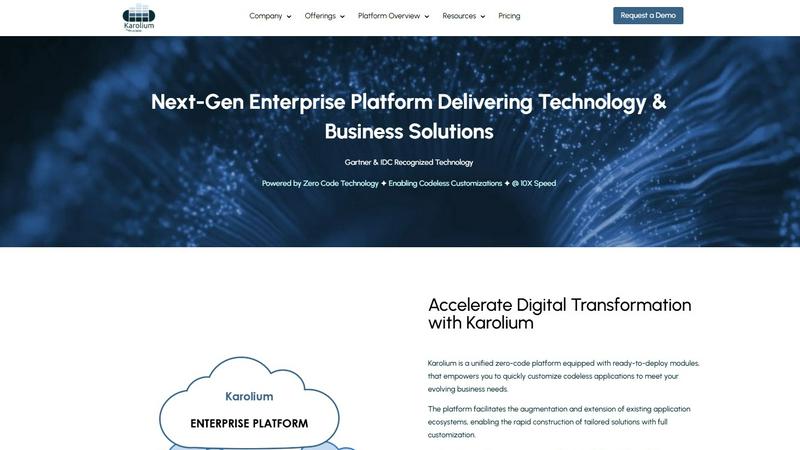
Karolium is a zero-code platform that builds custom AI business apps ten times faster.
Last updated: February 28, 2026
Visual Comparison
iGPT
Karolium
Feature Comparison
iGPT
Unified Intelligence Endpoint
Replace complex, multi-step retrieval architectures with a single API call. iGPT consolidates the entire process—from understanding your natural language query to retrieving relevant data across emails and attachments, shaping the optimal context, and delivering a reasoned response—into one streamlined pipeline. This eliminates the need to manage separate systems for parsing, vector stores, and prompt chains, dramatically accelerating development.
Deep Email & Attachment Processing
iGPT goes beyond simple email text. It automatically and deeply indexes the full content of email conversations, including reconstructing threads across time and participants. Crucially, it processes attachments—extracting text, data, and structure from documents, PDFs, and spreadsheets—to understand the complete context of a communication, ensuring no critical information buried in a file is missed.
Context Engineering Framework (CEF)
This proprietary system automatically optimizes how context is retrieved and presented to your LLM. It employs hybrid retrieval (semantic, keyword, and filters), scores and re-ranks results, and shapes the context window specifically for your query. This means developers get high-quality, relevant context without the manual, iterative work of prompt engineering and tuning, leading to more accurate and reliable agent outputs.
Enterprise-Grade Security & Governance
iGPT is built with strict compliance and data control in mind. It features a zero-data training policy, ensuring your data is never used to improve models. It offers Role-Based Access Control (RBAC) with OAuth enforcement, processes data in memory with zero retention, and provides a full audit trail for every request. This allows enterprises to leverage powerful AI while keeping data securely within their control.
Karolium
Unified Zero-Code Platform
Karolium integrates iPaaS, aPaaS, oPaaS, and AIPaaS capabilities into a single, cohesive environment. This unified architecture allows enterprises to connect systems, build applications, manage operations, and embed AI all without traditional coding. It eliminates dependency on developer teams for every change, granting business users the power to compose and modify workflows directly, dramatically accelerating development cycles and reducing IT backlog.
Pre-Composed Value Chain Modules
The platform offers a suite of ready-to-use, enterprise-grade modules for critical business functions like Supplier Collaboration, Centralized Procurement, AI-Infused Demand Forecasting, and Warehousing. These pre-built solutions provide immediate functionality, allowing businesses to deploy core capabilities rapidly. They are fully composable, meaning they can be used as-is, extended, or customized to fit specific operational workflows without point-to-point integrations or costly redevelopment.
Codeless Customization Engine
At the heart of Karolium is a powerful visual development environment that enables boundless customization. Users can tailor pre-packaged modules or build entirely new applications by dragging and dropping components, defining business logic, and designing interfaces. This engine ensures that the software can adapt precisely to unique business processes, overcoming the limitations of generic off-the-shelf applications while maintaining a 10x faster implementation speed compared to coded solutions.
Built-In Enterprise Intelligence (AIPaaS)
Karolium bakes AI directly into the platform, offering both out-of-the-box predictive and prescriptive solutions (like lead time prediction and asset monitoring) and a flexible environment for creating custom AI-driven applications. This lowers the barrier to AI adoption, allowing companies to leverage machine learning for tangible outcomes such as optimized forecasting, automated image recognition, and data-driven decision-making within their everyday workflows.
Use Cases
iGPT
AI-Powered Email Assistants
Build intelligent agents that can draft, prioritize, summarize, and act on email with full historical and attachment context. Instead of agents working in a vacuum, they can understand the entire conversation thread, participant sentiments, and referenced documents to generate highly relevant and actionable responses, turning your inbox into an automated productivity hub.
Customer Support & Success Copilots
Empower support teams with agents that instantly rebuild the complete customer story. By analyzing long email chains, attachments, and subtle tone shifts, iGPT provides copilots with a unified view of the issue history, past resolutions, and outstanding commitments. This leads to faster, more personalized support and higher customer satisfaction.
Sales & CRM Intelligence Automation
Automatically extract crucial deal intelligence directly from email threads. iGPT can identify key decisions, action items, owners, deadlines, and changes in deal momentum that are often communicated informally over email. This data can be pushed to CRM systems, giving revenue teams real-time, context-rich insights without manual entry.
Compliance & Audit Trail Generation
Automate the tracking of approvals, feedback, and rationale buried in email communications. iGPT can trace specific decisions or statements back to their source messages and attachments, creating a verifiable audit trail. This is essential for legal, financial, and regulatory compliance, saving countless hours of manual email discovery.
Karolium
Accelerating Digital Transformation Initiatives
Enterprises aiming to modernize their technology stack can use Karolium to rapidly build and deploy new applications that fill critical gaps. Instead of multi-year coding projects, teams can compose solutions in weeks or months, connecting legacy systems and modern microservices to create a cohesive, agile digital ecosystem that responds quickly to market changes and new opportunities.
Extending and Augmenting Existing ERP/CRM Systems
Organizations frustrated by the rigid functionality of their core ERP or CRM software can use Karolium to add missing features and tailor workflows without costly vendor upgrades or custom code. The platform seamlessly integrates with existing systems, allowing businesses to enhance their core investments with customer-centric features, specialized compliance checks, or unique process automations.
Implementing AI-Driven Supply Chain Optimization
Companies can deploy Karolium's pre-composed supply chain modules, such as AI-Infused Demand Forecasting and Smart Compliance, to move from reactive to proactive operations. The built-in intelligence helps predict disruptions, optimize inventory, and automate supplier collaboration, leading to reduced costs, improved efficiency, and greater resilience against market volatility.
Creating Custom Intelligent Applications for Line of Business
Departments with unique needs—such as contract manufacturing scheduling or specialized asset monitoring—can leverage the zero-code environment and AIPaaS capabilities to build their own AI-powered applications. This empowers subject matter experts to solve their own challenges with tailored software that provides predictive insights and process automation, driving measurable business outcomes.
Overview
About iGPT
iGPT is an enterprise-grade email intelligence API designed to solve a critical and costly problem: the failure of standard AI to understand the complex, unstructured data within business email communications. Email is where real work happens, containing vital context across threads, attachments, and participant dynamics, yet this richness is often lost on AI agents. iGPT acts as a secure and auditable gateway, enabling AI agents and automated workflows to access, comprehend, and leverage this buried context. Built for developers and enterprises, it serves teams building agentic systems, sales intelligence platforms, customer success tools, and compliance solutions that require deep, real-time insight from communication data. Its core value proposition is delivering trusted, context-aware answers from messy email data through a single, unified API call. This eliminates the traditional engineering heavy-lifting of parsing, chunking, indexing, and endless prompt tuning. Instead, iGPT offers a streamlined pipeline that handles intelligent retrieval, context shaping, and reasoning automatically. With a foundational focus on end-to-end security, granular access controls, and comprehensive audit trails, iGPT empowers businesses to deploy powerful, context-aware AI agents with confidence while maintaining strict data governance and compliance standards.
About Karolium
Karolium is a next-generation, unified zero-code enterprise platform designed to solve the core challenges of digital transformation and intelligent application development. It is specifically built for enterprises seeking agility, efficiency, and intelligence. The platform uniquely combines ready-to-deploy value chain modules with a powerful codeless customization engine, enabling businesses to rapidly build, extend, and customize software applications without writing a single line of code. This approach directly addresses the frustration of rigid off-the-shelf software and the high cost and slow pace of traditional custom development, allowing companies to augment their existing application ecosystems at 10x the speed. Furthermore, Karolium integrates enterprise intelligence directly into the workflow as an AIPaaS, offering built-in predictive and prescriptive AI solutions. This empowers organizations to not only streamline operations but also to create their own AI-driven business applications, making advanced analytics and automation accessible for tangible business outcomes. Delivered as a managed PaaS-driven SaaS subscription, Karolium provides continuous updates, supports unlimited users, and offers boundless customization, ensuring the platform evolves seamlessly with shifting market demands and enterprise needs.
Frequently Asked Questions
iGPT FAQ
How does iGPT handle data privacy and security?
iGPT is architected for enterprise security. It operates on a zero-data training and zero-data retention policy, meaning your data is never used to train models and is not stored after processing. All inferences happen in memory. It enforces strict OAuth-based Role-Based Access Control (RBAC) and provides full audit trails, ensuring data never leaves your company's control and every access is traceable.
What types of email sources and attachments can it connect to?
iGPT can connect to enterprise email systems like Google Workspace and Microsoft 365 via secure OAuth. It deeply indexes email content and threads. For attachments, it processes a wide range of formats, including PDFs, Word documents, Excel spreadsheets, and PowerPoint presentations, extracting text and structural data to understand the full context of the communication.
Do I need to manage vector databases or complex prompt chains?
No. A core benefit of iGPT is that it abstracts away this infrastructure complexity. You do not need to set up parsing, chunking, vector stores, or design intricate prompt chains. The unified API and its built-in Context Engineering Framework handle retrieval, context optimization, and reasoning automatically based on your simple natural language query.
What is the Context Engineering Framework (CEF)?
The Context Engineering Framework (CEF) is iGPT's intelligent retrieval and reasoning pipeline. It automatically performs hybrid search (combining semantic and keyword techniques), filters, re-ranks results, and optimally shapes the context window for your specific query and chosen LLM. It delivers high-quality context so you don't have to manually tune prompts, ensuring faster and more reliable outcomes.
Karolium FAQ
What is a zero-code platform, and how is Karolium different?
A zero-code platform allows users to build and modify software applications using visual tools and configuration instead of traditional programming. Karolium is different because it is a unified enterprise platform that combines this codeless development with pre-built value chain solutions and built-in AI (AIPaaS). It's not just a tool for simple apps; it's designed for complex, mission-critical enterprise transformations, offering both ready-to-deploy modules and deep customization at scale.
Can Karolium integrate with our current legacy systems?
Yes, seamless integration is a core capability. Karolium's iPaaS (Integration Platform as a Service) functionality is built to connect with a wide array of legacy systems, modern microservices, databases, and APIs. This allows you to augment your existing application ecosystem without the need for disruptive "rip-and-replace" projects, protecting your current investments while adding new functionality.
Who typically uses the Karolium platform within an organization?
While IT departments manage governance and deployment, the primary users are often business analysts, process owners, and subject matter experts from units like supply chain, procurement, and operations. The zero-code environment empowers these professionals to configure workflows, build reports, and modify applications directly, reducing their dependency on dedicated development teams for every change request.
How does the SaaS subscription model work and what does it include?
Karolium is delivered as a managed PaaS-driven SaaS (Platform/Software as a Service). Your subscription includes continuous access to the core platform, all its technology enablers, automatic updates, and new module releases (typically quarterly). It also covers platform hosting, security, and maintenance. The model supports unlimited users and offers boundless customization, ensuring your solutions grow and adapt with your business needs over time.
Alternatives
iGPT Alternatives
iGPT is an enterprise-grade email intelligence API that falls into the business intelligence category. It specializes in giving AI agents secure, contextual answers from complex email threads and attachments, eliminating the heavy engineering typically required to process unstructured communication data. Users often explore alternatives for various practical reasons. These can include budget constraints, the need for different feature sets like integration with other data sources, or specific platform requirements that may not align with a single vendor's offering. It's a natural part of the evaluation process for any technical solution. When assessing other options, focus on core capabilities. Key considerations should be the depth of email and attachment understanding, the robustness of security and audit controls, the simplicity of the developer API, and the system's ability to reconstruct full conversation narratives in real time. The right tool should reliably turn messy email data into actionable intelligence without creating new operational burdens.
Karolium Alternatives
Karolium is a zero-code platform in the enterprise application development category. It enables businesses to build and customize AI-driven software rapidly without traditional coding, addressing the need for agility beyond rigid off-the-shelf solutions or slow custom projects. Users often explore alternatives for various reasons. These can include budget constraints, specific feature requirements not covered by the platform, or a need for a different deployment model. The search is typically driven by finding the optimal fit for an organization's unique technical landscape and strategic goals. When evaluating alternatives, key considerations should include the platform's core capabilities in visual development, the availability of pre-built modules for your industry, and the depth of its built-in intelligence features. It's also crucial to assess scalability, security, and the total cost of ownership to ensure a long-term strategic fit.