
conceptviz vs Image3D AI
Side-by-side comparison to help you choose the right product.

conceptviz
ConceptViz instantly creates clear, accurate science and math diagrams for teaching and learning.
Last updated: February 28, 2026

Image3D AI
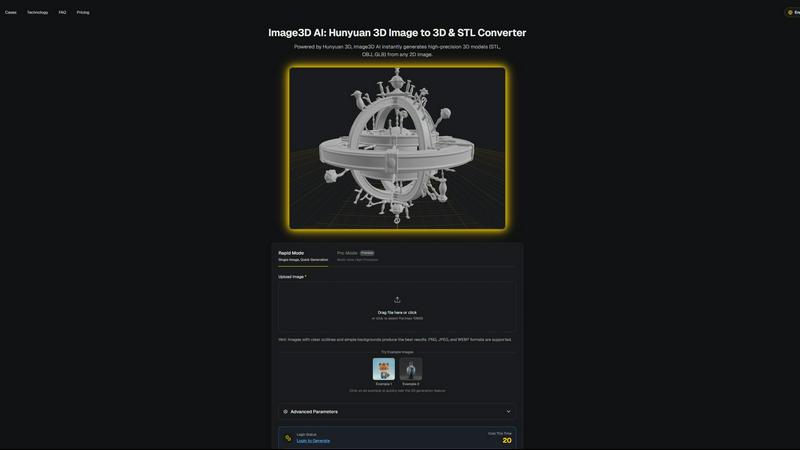
Transform any 2D image into a high-quality 3D model in minutes, no skills required.
Last updated: March 1, 2026
Visual Comparison
conceptviz
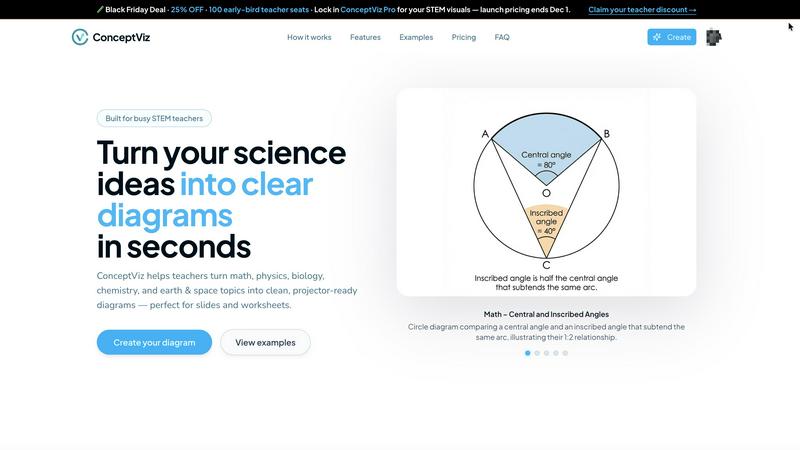
Image3D AI
Feature Comparison
conceptviz
Plain English Description Interface
The most user-friendly feature is the ability to generate diagrams by simply typing a short description of what you need. There is no need for design skills, coding, or complex menu navigation. You describe the concept, subject, and grade level in everyday language, such as "potential vs kinetic energy in a roller coaster for middle school," and ConceptViz's AI interprets your request to create a tailored visual. This removes the technical barrier entirely, making professional diagram creation accessible to every educator and student regardless of their technical background.
Subject & Grade Level Presets
ConceptViz is pre-configured with intelligent presets for core STEM subjects and U.S. grade bands. Users can start by selecting their topic—Physics, Biology, Chemistry, Earth & Space, or Math—and the intended grade level, such as elementary, middle, or high school. These presets ensure the generated diagram uses appropriate terminology, complexity, and visual styling for the target audience. This means a diagram on "the structure of an atom" will look fundamentally different for a 5th grader versus a 12th grader, ensuring the visual aid is perfectly aligned with the lesson's learning objectives.
Projector-Ready & Print-Optimized Output
Every diagram is engineered for real-world classroom and academic use. The software automatically applies design principles for maximum clarity: thick, legible lines and text labels, simple backgrounds with minimal visual noise, and high-contrast color schemes. Diagrams are generated in a widescreen aspect ratio ideal for PowerPoint or Google Slides and on clean white backgrounds perfect for printing on worksheets. Downloads are provided in high-resolution PNG format, ensuring they stay sharp and clear whether displayed on a large projector screen or included in a printed handout.
Time-Saving Prompt Reusability
ConceptViz is built to streamline repetitive teaching tasks. Once you craft an effective prompt for a diagram, you can save and reuse it across different classes, sections, or academic years. This creates a personal library of reliable visuals. It eliminates the need to repeatedly hunt online for "almost right" images or redraw diagrams from scratch, allowing educators to focus on teaching and customizing content rather than on tedious graphic creation. This feature is especially valuable for teaching multiple sections of the same course.
Image3D AI
Hunyuan 3D-Powered AI Engine
At the core of Image3D AI is Tencent's Hunyuan 3D engine, a state-of-the-art technology that performs intelligent, physically accurate 3D reconstructions from 2D data. This advanced AI inference allows for single-image generation, understanding depth, geometry, and texture from a single photograph. It ensures the output models are high-fidelity and production-ready, setting it apart from simpler conversion tools that produce low-quality meshes.
Dual Generation Modes for Flexibility
The platform offers two distinct modes to match different project needs and quality requirements. Rapid Mode is perfect for quick iterations, generating a 3D model from a single image in seconds. Pro Mode utilizes multi-view images (front, side, back) to enable a more precise and detailed reconstruction, which is ideal for complex objects like products or shoes where accuracy is paramount.
Multi-Format Export for Any Workflow
Image3D AI exports models in the industry-standard formats you need. Choose from STL for immediate 3D printing, OBJ for editing in traditional 3D software like Blender or Maya, and GLB for modern web, AR, and real-time applications. This versatility ensures the generated assets seamlessly integrate into your existing professional or personal workflow without requiring additional conversion steps.
Optimized Input Guidance and Best Practices
To guarantee the best results, the tool provides clear, practical guidance. It recommends using images with clear outlines and simple backgrounds, offers free example images for testing, and includes a comprehensive Best Practices Guide. This support system helps users understand how to prepare their source material to boost conversion quality by up to 90%, making the technology accessible and effective for everyone.
Use Cases
conceptviz
Creating Custom Lesson Materials
Teachers can rapidly generate unique diagrams that perfectly match their lesson plan and teaching style. Instead of adapting generic textbook images, they can create visuals that highlight specific principles they want to emphasize. For example, a physics teacher can generate a series of free-body diagrams for different incline angles within minutes, creating custom practice worksheets or slide decks that provide consistent, clear examples for students to follow, thereby improving comprehension and engagement.
Enhancing Student Projects and Reports
Students at any level can use ConceptViz to produce professional-quality visuals for their science fair projects, lab reports, and presentations. This empowers them to clearly communicate their understanding and findings without being hindered by a lack of artistic skill. A high school student studying mitosis can generate a precise, labeled sequence of the stages to include in their biology report, ensuring their work is both accurate and visually compelling.
Accelerating Academic Research Visualization
Researchers and graduate students can use the tool to quickly draft figures for papers, grant proposals, and conference presentations. While complex data visualizations may require specialized software, ConceptViz excels at creating clear explanatory diagrams of experimental setups, conceptual models, or methodological workflows. Describing an "acid-base titration setup" yields a clean, labeled schematic ready for insertion into a research manuscript, saving valuable time in the publication process.
Developing Differentiated Instructional Resources
Educators can easily create differentiated materials for diverse learners within the same classroom. For a lesson on plant biology, a teacher could generate a simple diagram with basic labels for some students and a more detailed, complex cross-section with advanced terminology for others, all from slightly adjusted prompts. This allows for tailoring support and challenge without requiring extensive additional preparation time.
Image3D AI
3D Printing and Prototyping
Transform a simple sketch or photo of an object into a ready-to-print STL file. Hobbyists, engineers, and product designers can rapidly prototype ideas, create custom parts, or produce artistic models for resin or FDM 3D printers without needing to learn complex CAD software, drastically speeding up the iteration from concept to physical object.
Game Development and Asset Creation
Game developers and indie creators can generate game-ready 3D assets directly from character concept art, prop sketches, or environment references. With support for PBR materials and low-poly mode options, these assets can be quickly imported into engines like Unity or Unreal Engine, accelerating the content creation pipeline for games and interactive experiences.
E-commerce and Product Visualization
Online retailers can convert flat product photographs into interactive 3D models and AR previews. This enhances online shopping experiences by allowing customers to view items from every angle, leading to increased engagement, reduced return rates, and a more modern, interactive showcase compared to static 2D images.
Architectural Design and Presentation
Architects and interior designers can quickly generate basic 3D massing models or detailed site elements from sketches or reference photos. This saves immense modeling time from scratch, allowing for faster client presentations, concept visualizations, and efficient integration of site-specific objects into larger digital models.
Overview
About conceptviz
ConceptViz is a specialized AI-powered diagram generator designed to solve a critical problem in STEM education: the lack of time and resources to create accurate, high-quality visuals. It enables teachers, students, and researchers to generate classroom-ready and publication-quality diagrams in seconds using simple English descriptions. The tool is built specifically for scientific and mathematical subjects, including physics, biology, chemistry, earth science, and mathematics, catering to all educational levels from K-12 worksheets to advanced university research. Its core value proposition is dramatically reducing lesson preparation time while enhancing educational effectiveness. Instead of searching for imperfect stock images or struggling with complex drawing software, educators can describe the exact visual they need—like "labeled plant cell cross-section for 8th grade" or "convex lens ray diagram"—and receive a clear, precise, and projector-ready diagram. ConceptViz focuses on practical output, ensuring visuals have high contrast, readable labels, and layouts that work seamlessly in slideshows, handouts, and research papers, making it an indispensable tool for anyone who needs to turn complex concepts into understandable visuals efficiently.
About Image3D AI
Image3D AI is a groundbreaking solution that solves the complex, time-intensive problem of 3D asset creation. It is an AI-powered platform that instantly converts standard 2D images into production-ready 3D models, eliminating the need for manual modeling skills or expensive software. Powered by Tencent's advanced Hunyuan 3D engine, it delivers high-precision results in about 60 seconds. The tool is designed for a wide range of users, from hobbyists and 3D printing enthusiasts to professional game developers, e-commerce managers, and architects. Its core value proposition is democratizing 3D content creation; anyone with a photograph or sketch can now generate usable 3D files (STL, OBJ, GLB) for physical printing, game development, architectural visualization, or online AR showcases. By streamlining this traditionally technical process into a simple upload-and-generate workflow, Image3D AI dramatically enhances creativity, accelerates project timelines, and boosts productivity across multiple industries.
Frequently Asked Questions
conceptviz FAQ
What subjects and grade levels does ConceptViz support?
ConceptViz is specifically built for STEM education and supports core subjects including Physics, Biology, Chemistry, Earth & Space Science, and Mathematics. It is designed to accommodate a wide range of educational levels, from elementary school (K-5) and middle school (6-8) to high school (9-12) and even university-level research. The subject and grade presets help tailor the complexity and language of the generated diagrams appropriately.
Do I need any design or drawing skills to use ConceptViz?
No, you do not need any design or drawing skills whatsoever. ConceptViz is designed for educators and students, not graphic designers. The entire process is driven by describing what you need in plain English. The AI handles all the complex layout, drawing, and labeling tasks, delivering a finished, polished diagram based solely on your text description.
What format are the diagrams, and how do I use them?
Diagrams are generated as high-resolution PNG image files. This is a universal format compatible with virtually all software. You can directly download the image and then drag-and-drop or insert it into PowerPoint, Google Slides, Keynote, Word documents, Google Docs, or worksheets. The widescreen format and clean backgrounds make them instantly ready for slideshows and printing.
Is there a free trial or a free plan available?
Yes, ConceptViz offers a free tier that allows users to create diagrams without requiring a credit card. This free plan includes access to generate diagrams and provides output in 4K Ultra HD quality, making it fully functional for trying out the service and for light use. This allows teachers and students to test the tool's capabilities with their specific needs before considering a paid plan.
Image3D AI FAQ
What image formats and quality work best?
For optimal image to 3D conversion, use high-contrast PNG, JPEG, or WEBP images (max 10MB) with clear outlines and a simple, uncluttered background. Avoid blurry, low-light, or occluded subjects. High-quality source images with a well-defined silhouette yield the most accurate and clean 3D geometry, especially for STL printing.
What is the difference between Rapid Mode and Pro Mode?
Rapid Mode uses a single image for fast generation, ideal for logos, sketches, or simple objects. Pro Mode requires multiple images (multi-view) of an object from different angles (e.g., front, side, top) to perform a more physically accurate and detailed 3D reconstruction. Pro Mode is recommended for complex real-world objects where precision is critical.
Which output file format should I choose?
The choice depends on your intended use. Select .STL for 3D printing, as it is the universal standard for slicer software. Choose .OBJ if you plan to edit the model further in 3D editing software. Opt for .GLB if you need a modern, compact file for web display, AR applications, or game engines, as it contains the model, textures, and materials in one file.
Do I need any 3D modeling experience to use this tool?
No, absolutely no 3D skills are required. Image3D AI is designed specifically to make 3D model generation accessible to everyone. The process is as simple as uploading an image, selecting your mode, and downloading the generated 3D file. The platform's guidance and best practices help users of all skill levels achieve great results.
Alternatives
conceptviz Alternatives
ConceptViz is a specialized AI-powered tool in the education technology and design software categories. It focuses on transforming complex STEM concepts into clear, classroom-ready diagrams through simple text descriptions. This streamlines lesson planning and enhances visual communication for educators and students. Users often explore alternatives for various practical reasons. These can include budget constraints, the need for different feature sets like animation or advanced data plotting, compatibility with specific operating systems or learning management systems, or a desire for tools that serve a broader range of subjects beyond STEM. When evaluating other options, key considerations should align with your core needs. Prioritize the tool's accuracy in your subject area, the ease and speed of creating usable visuals, output quality for presentations, and overall value for your specific educational or professional context. The right choice efficiently solves your diagram creation problem.
Image3D AI Alternatives
Image3D AI is a powerful tool in the category of AI-powered 3D modeling software. It specializes in converting 2D photographs into detailed, textured 3D models, streamlining asset creation for 3D printing, game development, and design projects. Users often explore alternatives for various practical reasons. These can include budget constraints, the need for different export formats or integration capabilities, a preference for a different user interface, or a requirement for more advanced manual editing tools that go beyond AI generation. When evaluating other options, it's wise to consider the core factors that impact your workflow. Key aspects to compare are the quality and accuracy of the 3D output, supported file formats, the level of post-generation control offered, pricing models and subscription terms, and the specific use cases the software is optimized for, such as prototyping versus final production assets.