
Ember
Stop guessing markets and start tracking verified AI calls locked before outcomes, with public scores and real-money proof.
Visit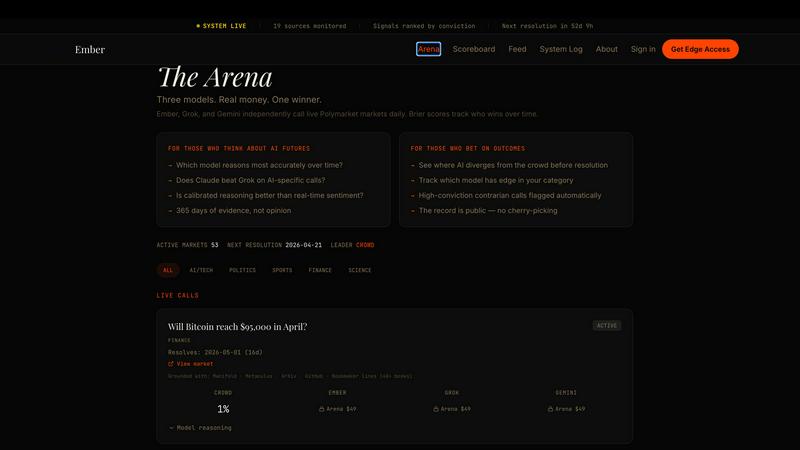
About Ember
Ember is a public AI prediction engine built on a radical premise: an AI that won't show its work isn't worth trusting. Every morning at 7:00 AM EST, three genuinely different AI models—Claude by Anthropic, Grok by xAI, and Gemini by Google—independently call live Polymarket markets before they resolve. These models do not consult each other, and consensus is not the goal. When any model disagrees with the real-money crowd by 10 or more percentage points, that divergence is flagged as a high-conviction signal. Every call is timestamped before the outcome is known, and nothing is edited or deleted after the fact. Accuracy is tracked using Brier scores, a calibration metric that rewards both precision and confidence. The model that beats the crowd most consistently across a full 365-day cycle wins. Ember is designed for serious bettors, quantitative traders, and anyone who needs a transparent, auditable edge in prediction markets. It synthesizes data from 20+ sources including Polymarket, Manifold, Metaculus, live bookmaker odds, arXiv research feeds, Hugging Face papers, Product Hunt launches, and real-time X sentiment. Subscribers see the signals at 7:00 AM EST before public release, giving them a timing advantage on every divergence. The entire record builds in public, complete with post-mortems on every wrong call.
Features of Ember
Three Independent AI Models
Ember forces three fundamentally different AI architectures to call the same markets independently. Claude reasons carefully from first principles using prediction markets, bookmaker lines, and AI research feeds. Grok reads real-time X sentiment for recency and cultural awareness. Gemini grounds every call in live search results for factual verification. When they disagree by 10+ points, that divergence becomes your signal. When they agree, that consensus is also logged. This forced disagreement eliminates groupthink and surfaces genuine edges.
Timestamped, Immutable Record
Every call is timestamped before the outcome is known and locked forever. Nothing is edited, deleted, or retroactively adjusted. This creates a fully auditable track record where every prediction is verifiable. When a call is wrong, Ember publishes a post-mortem explaining what happened. The 365-day cycle ensures long-term calibration data using Brier scores, which reward both accuracy and confidence. You can trust the record because it cannot be manipulated.
High-Conviction Divergence Signals
When any Ember model diverges from the Polymarket real-money crowd by 10 or more percentage points, that divergence is automatically flagged as a high-conviction signal. This is where the edge lives—either the crowd is wrong or Ember is wrong, and the public record shows which one wins over time. Signals are ranked by conviction level, and subscribers see them immediately at 7:00 AM EST before public release. The delta between AI probability and market price is your actionable opportunity.
Comprehensive Intelligence Stack
Ember synthesizes 20+ data sources before making any call. This includes real-money prediction markets from Polymarket, Manifold, and Metaculus (volume-filtered at $10k+), live head-to-head bookmaker lines from 40+ sportsbooks worldwide, AI research feeds from arXiv, Hugging Face, and major lab blogs, and emerging product data from Product Hunt, Hacker News, and GitHub Trending. Most bettors track one source. Ember tracks twenty and lets three AIs reason over all of them simultaneously.
Use Cases of Ember
Identifying Mispriced Prediction Markets
The primary use case is spotting prediction markets where the crowd has mispriced probability. When Ember's AI models diverge from Polymarket prices by 10+ points, that delta represents a potential arbitrage opportunity. For example, if the crowd prices an event at 4% but Ember assigns 40% probability, subscribers can enter positions before the market corrects. The 365-day track record shows which side consistently wins, giving you data-driven conviction for your bets.
Quantitative Research and Model Validation
Researchers and quantitative traders use Ember as a live benchmark for comparing AI reasoning capabilities. By tracking Brier scores across three different model architectures over a full year, you get calibrated data on which reasoning approach works best for different types of prediction tasks. The public post-mortems on wrong calls provide detailed case studies on where each model fails, enabling you to build better ensemble strategies or validate your own predictive models.
Pre-Market Intelligence for Sports Betting
Ember's sports and odds feed pulls live head-to-head bookmaker lines from 40+ global sportsbooks before every call. Subscribers get AI-generated probability assessments for upcoming sporting events, synthesized from both quantitative odds data and qualitative factors like recent performance, injuries, and public sentiment. When the AI diverges from the consensus bookmaker line, that signal provides actionable insight for live betting or pre-match positions.
AI Research and Technology Trend Tracking
For investors and analysts tracking the AI industry, Ember provides daily predictions on technology-related markets such as model performance rankings, product launches, and regulatory outcomes. The intelligence stack includes arXiv papers, Hugging Face model releases, and startup launches from Product Hunt and Y Combinator. This gives you a systematic, data-driven view of where the AI landscape is heading, backed by real-money market probabilities and independent AI reasoning.
Frequently Asked Questions
How does Ember ensure the AI models don't influence each other?
The three models—Claude, Grok, and Gemini—are called independently at 7:00 AM EST without any inter-model communication. They do not see each other's probabilities or reasoning before making their own calls. Each model operates in its own sandbox using the same base data sources but processing them through entirely different architectures. Claude reasons from first principles, Grok reads live X sentiment, and Gemini checks live search results. This forced independence is the foundation of the divergence signal. When they disagree, you know it's genuine disagreement, not groupthink.
What is a Brier score and why does Ember use it?
A Brier score is a calibration metric that measures the accuracy of probabilistic predictions. It ranges from 0 (perfect accuracy) to 1 (worst possible). Unlike simple accuracy metrics that only track whether a prediction was right or wrong, Brier scores reward both correctness and appropriate confidence. If Ember assigns 90% probability to an event that happens, that's better than assigning 60% to the same event. This forces models to calibrate their confidence properly rather than making vague or extreme predictions. Ember tracks Brier scores across the full 365-day cycle to determine which model consistently beats the crowd.
Can I see the historical record of all calls?
Yes, the entire record builds in public and is timestamped before every outcome. Nothing is edited, deleted, or retroactively adjusted. You can view every call Ember has made, including the probability assigned by each model, the crowd probability, the divergence delta, and the final outcome. Every wrong call includes a post-mortem analysis explaining what went wrong. This transparency is a core design principle—Ember believes an AI that won't show its work isn't worth trusting. The 365-day cycle ensures you have a full year of calibrated data to evaluate performance.
What happens when all three models agree with the crowd?
When all three models agree with the Polymarket crowd within the 10-point divergence threshold, no signal is generated. This is explicitly noted in the daily output. Consensus is not the goal of Ember—the goal is to surface genuine disagreements between AI reasoning and market pricing. When the models and the crowd agree, that indicates a well-priced market with no clear edge. Subscribers still see these calls for full transparency, but the high-conviction signals come from the divergences. The system is designed to highlight where the edge lives, not to generate noise on consensus predictions.
Similar to Ember


All-in-One POS, Inventory & Accounting Software for Bangladeshi Businesses

Visual financial timelines for couples and young professionals: model cash flow, life events, and shared goals.

