
Kompy
Get real-time Walmart product data as clean JSON including price history, stock, sellers, and reviews via REST API or MCP server for developers and.
Visit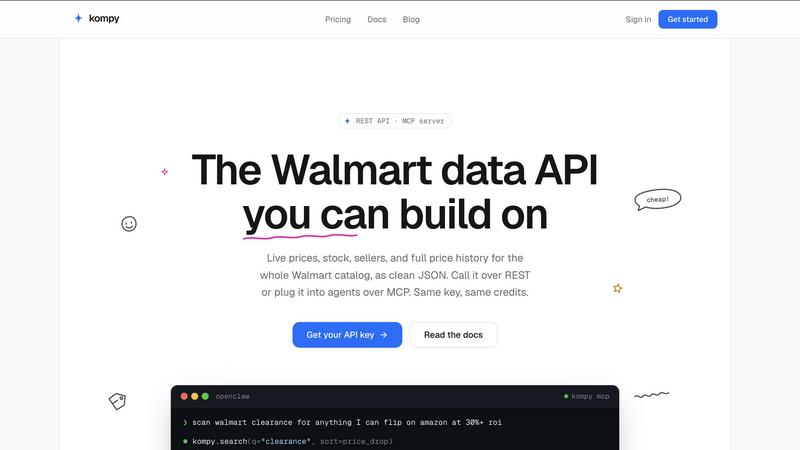
About Kompy
Kompy is a unified, structured data API for the Walmart marketplace, designed to eliminate the complexity and fragility of running your own web scrapers. Instead of building and maintaining brittle scraping infrastructure that breaks whenever Walmart updates its site, you get a single, reliable REST API and MCP server that returns clean, consistent JSON for products, search results, barcode lookups, seller offers, customer reviews, and full price and stock history. The core value proposition is simple: one integration replaces dozens of hours of scraping maintenance. Kompy is built for both humans and machines. Developers can call the REST API directly from any programming language, while AI agents and large language models can connect via the built-in MCP (Model Context Protocol) server to query Walmart data conversationally. The product targets a wide audience: ecommerce entrepreneurs flipping products for profit, developers building price tracking tools or market analysis dashboards, and AI engineers equipping their agents with real-world shopping data. With Google sign-in, instant API key generation, and a credit-based pricing model that scales from a solo side project to a production application serving thousands of users, Kompy lowers the barrier to entry for accessing high-quality, structured marketplace data. Every response includes a unique request ID for tracing, and the platform records hourly snapshots of price and stock changes for every tracked SKU, providing historical data that no other Walmart API offers. Kompy is not affiliated with or endorsed by Walmart Inc., but it provides the most developer-friendly and agent-compatible access to Walmart's catalog available today.
Features of Kompy
Unified REST API with Predictable JSON Responses
Kompy provides a single, documented REST API endpoint for every major Walmart data operation. Instead of juggling multiple scraping scripts or third-party libraries, you make one HTTP request and receive a deterministic JSON response. Every response includes a request_id for tracing, a latency_ms field, and a clean data object containing the requested information. The API supports standard HTTP methods and authentication via an API key passed in the X-API-Key header. No SDK is required, but examples are provided for curl, Python, Node.js, and Go. This simplicity means you can integrate Walmart product data into any application, from a simple command-line tool to a complex microservice architecture, in minutes.
First-Party MCP Server for AI Agents
Kompy ships a native MCP (Model Context Protocol) server that exposes every API operation as a callable tool for AI agents. This means you can connect tools like Claude Code, OpenClaw, Cursor, or any MCP-compatible agent to Kompy in seconds. The agent sees tools like kompy.product to fetch full product records, kompy.search to query the live catalog with sort and filters, kompy.history to retrieve per-seller price and stock history, and kompy.reviews to get customer reviews. The same API key works for both REST and MCP access, and the underlying data is identical. This feature is a game-changer for developers building autonomous ecommerce agents that need to make real-time buying decisions, find profitable flips, or monitor competitor pricing without writing any glue code.
Full Price and Stock History with Hourly Snapshots
Unlike most scraping solutions that only capture a snapshot at the moment of the request, Kompy records the Walmart marketplace around the clock. It takes hourly snapshots of price, stock, and buy-box changes for every SKU it tracks, storing this data per seller back to day one. This historical data is accessible via the dedicated history endpoint, which returns time-series data that can be used to analyze pricing trends, identify optimal buying windows, or backtest arbitrage strategies. For example, you can see exactly when a product dropped to its lowest price last Black Friday, how long it stayed there, and which seller was offering it. This feature is invaluable for anyone who needs to understand price dynamics, not just the current state.
Barcode Lookup and Seller Offer Data
Kompy goes beyond simple product search by offering a barcode lookup endpoint that returns the full product record from a UPC or EAN. This is critical for inventory management, retail arbitrage, and listing verification. Additionally, the API surfaces seller-level offer data, including which sellers are offering a product, their individual prices, stock status, and ratings. This granularity allows users to compare offers across multiple sellers, identify the best deal, and understand the competitive landscape of any given product. Combined with the product endpoint, you get a complete picture of the marketplace for any item, from the manufacturer's brand to the lowest current seller price.
Use Cases of Kompy
Retail Arbitrage and Product Flipping
The most immediate and profitable use case for Kompy is identifying products that can be bought on Walmart and resold at a higher price on another marketplace like Amazon. By using the search endpoint with sort parameters like price_drop or clearance, users can quickly surface products with significant price reductions. Then, the history endpoint reveals the price trajectory over the last 30 or 90 days, confirming the drop is genuine and not a temporary glitch. The product endpoint provides the current Walmart price, stock status, and seller information. With this data, a user can calculate potential ROI, factoring in fees and shipping, and execute a flip with confidence. Kompy's MCP server makes this workflow even faster: an AI agent can scan clearance items, analyze history, and report back which flips clear a specified profit margin, all in a single conversation.
Competitive Price Monitoring and Dynamic Pricing
Businesses that compete with Walmart or sell through the Walmart marketplace can use Kompy to monitor competitor pricing in real time. The API's search and product endpoints allow for automated, scheduled checks of key SKUs. When a competitor drops their price, the system can trigger an alert or automatically adjust your own pricing strategy. The historical data is crucial here, as it reveals whether a price drop is a permanent shift or a temporary promotion. By tracking the buy-box winner and its price over time, you can identify patterns in competitor behavior and optimize your own pricing to maximize margins while remaining competitive. This use case is particularly valuable for ecommerce operations with large catalogs that cannot be monitored manually.
Building AI-Powered Shopping Assistants
Developers building AI agents or chatbots that need to answer shopping-related questions can leverage Kompy's MCP server as a data source. An agent can be equipped with the ability to search for products, check prices, read reviews, and even track price history. For example, a user could ask, "Find me a 65-inch 4K TV under $500 with good reviews," and the agent would use kompy.search with filters, then call kompy.product on the top results to get detailed ratings and seller information. The agent could also answer questions like, "Has the price of this laptop dropped in the last month?" by querying the history endpoint. This creates a natural language interface to the entire Walmart catalog, making it easy for non-technical users to get actionable shopping intelligence.
Data-Driven Market Research and Trend Analysis
Analysts and researchers can use Kompy to gather large-scale datasets for market research. By programmatically querying the search and product endpoints across different categories, you can build a comprehensive picture of pricing, availability, and seller concentration on Walmart. The historical data allows for longitudinal studies, such as analyzing how prices change during holiday seasons or tracking the introduction of new sellers in a specific category. This data can feed into dashboards, reports, or machine learning models that predict price movements or identify emerging trends. Because the data is returned as clean JSON, it is easy to store in a database or data warehouse for further analysis.
Frequently Asked Questions
How is Kompy different from scraping Walmart myself?
Building and maintaining a web scraper for Walmart is a significant engineering effort. Walmart frequently changes its site structure, which breaks scrapers and requires constant updates. You also have to handle IP blocking, rate limiting, CAPTCHAs, and parsing messy HTML. Kompy handles all of this for you. It provides a stable, documented REST API and MCP server that returns clean, structured JSON. You get reliable data without the maintenance burden. Furthermore, Kompy stores historical price data that a simple scraper cannot provide unless it has been running continuously since the product was first tracked.
What data can I access with the Kompy API?
The Kompy API provides access to a wide range of Walmart marketplace data. You can get full product records including name, brand, price, currency, stock status, rating, review count, and seller information via the product endpoint. The search endpoint lets you query the live catalog with custom sort and filter parameters. The barcode lookup endpoint returns product data from a UPC or EAN. The offers endpoint provides seller-level pricing and stock details. The reviews endpoint returns customer reviews and ratings. Finally, the history endpoint provides per-seller price and stock history with hourly granularity back to day one.
How does the MCP server work with AI agents?
The MCP server is a separate interface that exposes the same data as the REST API but in a format that AI agents can use as callable tools. You add the MCP server to your agent's configuration (e.g., Claude Code, OpenClaw, Cursor) by providing the server URL and your API key. Once connected, the agent can use tools like kompy.search, kompy.product, kompy.history, and kompy.reviews just like any other tool. The agent decides when to call these tools based on the user's request. This eliminates the need for you to write any code to parse the user's intent or format API calls; the agent handles the entire workflow.
What is a credit and how is it used?
Kompy uses a credit-based pricing model. Each API request consumes a certain number of credits, typically one credit per request for standard endpoints like product lookup and search. More complex operations, such as history queries that return large datasets, may consume multiple credits. Your monthly plan includes a set number of credits. If you exceed your plan's credit limit, you can either wait for the next billing cycle or purchase additional credits. Unused credits do not roll over to the next month. The system is designed to be transparent, with no hidden fees, and every account starts with free credits to test the API.
Pricing of Kompy
Kompy offers three subscription tiers designed to scale with your usage. All plans include API access and MCP server access. The Hobby plan is $49.99 per month and includes 14,000 credits, suitable for individuals getting started with basic projects. The Pro plan is $149.99 per month and includes 45,000 credits, designed for professionals and small teams who need more capacity and priority support. The Business plan is $499.99 per month and includes 180,000 credits, built for large teams with custom needs, offering priority support and custom integrations. Every new account starts with free credits to test the service without any forced upgrade or dark patterns. You can compare all plans and features on the Kompy pricing page.
Similar to Kompy

Privacy-first, cookieless web analytics that ties your traffic and marketing channels to real Stripe revenue.

Online tally counter for tracking attendance, workouts, inventory, visitors, sports scores, habits, and everyday counting tasks.


Research keywords, competitors, backlinks and AI visibility inside Claude or Codex, with findings saved to your SEO dashboard.

Real-time App Store analytics with an AI copilot for portfolio owners.

privacy-first, AI-powered contact management platform

SnapPChart grades a trading chart screenshot A+ to F, with an entry, stop, targets, and risk/reward. Works on stocks, forex, crypto, futures.